
The global smart manufacturing market stood at $175 billion in 2025. By 2030, it is projected to reach $274 billion. (Source: MarketsandMarkets, “Smart Manufacturing Market — Global Forecast to 2030,” 2025, marketsandmarkets.com)
98% of manufacturers are exploring or considering AI-driven automation but only 20% say they feel fully prepared to use it at scale. The gap between exploring and deploying at scale is precisely what the next phase of industrial evolution is about. (Source: IBM Institute for Business Value, “The AI-Ready Manufacturer,” 2024, ibm.com/thought-leadership/institute-business-value)
Industry 6.0 is the emerging term for this next phase: a manufacturing paradigm in which large language models govern heterogeneous fleets of robots, AI agents manage production scheduling, and the factory itself becomes an autonomous system that can translate business objectives directly into executed operations with minimal human intervention.
This guide explains the industrial evolution from Industry 1.0 to 6.0, what distinguishes Industry 6.0 from its predecessors, the core technologies that enable it, the data infrastructure it requires, and the realistic picture of where the industry stands today versus where it is heading.
The Industrial Evolution: 1.0 to 6.0
Each industrial era has been defined by the convergence of a small number of enabling technologies that transformed production economics.
| Era | Period | Defining Technology | What Changed in Manufacturing |
| Industry 1.0 | 1760s–1850s | Steam power, mechanization | Human and animal labor replaced by machines; factory system emerges |
| Industry 2.0 | 1870s–1950s | Electricity, assembly lines | Mass production; standardization; Ford’s moving assembly line |
| Industry 3.0 | 1960s–1990s | Computers, PLCs, automation | Programmable control; numerical control machining; early robots |
| Industry 4.0 | 2000s–2020s | IoT, cyber-physical systems, data | Connected factories; real-time data analytics; digital twins |
| Industry 5.0 | 2018–present | Human-AI collaboration, cobots | Human-centric automation; collaborative robots; resilience focus |
| Industry 6.0 | Emerging | LLMs, agentic AI, autonomous systems | Prompt-to-product; AI-governed robot fleets; cognitive factories |
What Industry 4.0 and 5.0 Established
Understanding Industry 6.0 requires understanding what the two preceding eras built.
Industry 4.0 created the connected factory. Sensors, industrial IoT platforms, cloud connectivity, and digital twins gave manufacturers real-time visibility into production operations that had previously been opaque.
By early 2026, 47% of global manufacturing operations had integrated smart systems up 12 percentage points in a single year. Industry 4.0 investments established the data infrastructure on which everything that follows depends. (Source: Deloitte, “2026 Manufacturing Industry Outlook,” deloitte.com/us/manufacturing-outlook)
Industry 5.0 introduced a human-centric counterbalance to the automation-first orientation of Industry 4.0. The European Commission’s Industry 5.0 framework emphasized resilience, sustainability, and the collaboration between human workers and machines rather than the replacement of humans by automation.
Collaborative robots (cobots) that can work safely alongside humans without traditional safety barriers represent the practical expression of this philosophy. The cobot market reached $11.3 billion in 2026, with 210,000 units shipped over four quarters. (Source: Interact Analysis, “Collaborative Robot Market Report,” 2026, interactanalysis.com)
Industry 6.0 does not discard these foundations it builds on them. The connected factory of Industry 4.0 provides the data substrate. The human-centred collaboration principles of Industry 5.0 remain embedded in how Industry 6.0 is expected to interact with human workers.
What Industry 6.0 adds is cognitive autonomy: the ability of the manufacturing system itself to reason, plan, and act on objectives rather than simply executing pre-programmed instructions.
What Defines Industry 6.0
Industry 6.0 is characterised by three capabilities that did not exist in previous industrial eras.
LLM-governed manufacturing systems
In Industry 4.0 and 5.0, automation systems follow rules. A robot arm performs a defined sequence of movements. A production scheduler applies defined optimization logic. The behavior is determined by human-programmed instructions.
In Industry 6.0, large language models provide the reasoning layer. Instead of programming explicit rules, manufacturers provide objectives in natural language or structured prompts and the AI system interprets those objectives, plans the required actions, and directs the execution of those actions across the available robotic and automated infrastructure.
Researchers at Skoltech demonstrated a prototype of this architecture using OpenAI’s GPT-4, LangChain, and LangGraph. A distributed AI system generated 3D blueprints autonomously, converted them into print-ready files, coordinated drone-based logistics, and executed robotic assembly all from simple natural language prompts. (Source: Boyko, N. et al., “Agentic AI for Autonomous Manufacturing,” Skolkovo Institute of Science and Technology, 2024, arxiv.org)
The results: production time reduced by 77%, blueprint generation cut from 24 minutes to 30 seconds. (Source: Boyko, N. et al., Skolkovo Institute of Science and Technology, 2024, arxiv.org)
In this model, the factory becomes what researchers describe as a “semantic environment” a space where intentions are translated directly into execution via knowledge-informed reasoning. The competitive advantage shifts from who can program the most sophisticated automation rules to who has the best semantic infrastructure governing the manufacturing system.
Heterogeneous robot swarm coordination
Industry 3.0 and 4.0 automation typically involved a single robot type performing a defined task: a welding arm, a CNC machine, a conveyor system. Each was programd separately, operated independently, and required significant reconfiguration to change tasks.
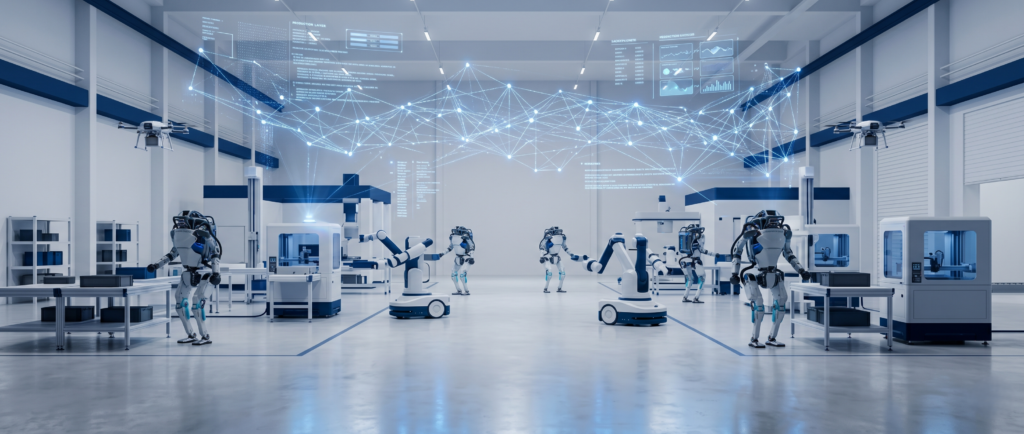
Industry 6.0 envisions heterogeneous swarms: AI-governed fleets combining manipulator arms, mobile autonomous robots (AMRs), drones, 3D printers, inspection systems, and humanoid robots each with different capabilities, coordinated by a central AI layer that assigns tasks based on objective, current machine state, and available resources.
Boston Dynamics’ Atlas humanoid robot began its first field test at Hyundai’s Georgia plant in January 2026, performing roof rack sorting tasks autonomously. (Source: Boston Dynamics, “Atlas at Hyundai,” bostondynamics.com, January 2026) NVIDIA’s CES 2026 announcement that “the ChatGPT moment for physical AI has arrived” was accompanied by new robot-specific chips and AI models. (Source: NVIDIA, CES 2026 Keynote, nvidia.com/ces2026)
Caterpillar announced expanded cooperation with NVIDIA to bring AI and autonomy to construction and mining machinery. (Source: Caterpillar, “Caterpillar and NVIDIA Expand Collaboration,” caterpillar.com/news, 2025)
The coordination challenge is significant. Heterogeneous robot swarms require real-time communication between machines with different protocols, different data formats, and different physical operating envelopes. Solving this coordination problem is a data engineering challenge as much as a robotics one.
Agentic AI in production operations
Agentic AI takes AI beyond recommendation and into autonomous action. An AI agent does not just predict that a machine is likely to fail, it schedules the maintenance, orders the replacement part, and adjusts the production schedule to route work around the affected machine, all without human instruction.
IDC predicts that by 2026, more than 40% of manufacturers with production scheduling systems will upgrade them with AI-driven capabilities enabling autonomous processes. (Source: IDC, “FutureScape: Worldwide Manufacturing 2026 Predictions,” idc.com)
By 2027, 40% of all operational data will be integrated across applications and platforms autonomously due to AI agents purpose-built for specific data. By 2028, 65% of G1000 manufacturers will use AI agents in conjunction with design and simulation tools to continuously validate design changes. (Source: IDC, “FutureScape: Worldwide Manufacturing 2026 Predictions,” idc.com)
The NAM’s Manufacturing Trends 2026 report describes the current shift as “moving decisively toward operations that can sense, respond, and optimize with minimal human intervention.” Systems that once made recommendations now adjust equipment automatically. (Source: National Association of Manufacturers, “Manufacturing Trends 2026,” nam.org)
The Data Infrastructure Industry 6.0 Requires
Industry 6.0’s autonomous operations depend on data infrastructure that most manufacturers have not yet fully built. The 80% of manufacturers who feel unprepared for AI at scale are predominantly limited by data infrastructure gaps, not AI capability gaps.
Unified IT/OT data integration
Traditional manufacturing has a fundamental data divide: Information Technology (IT) systems ERP, MES, PLM, CRM handle business data. Operational Technology (OT) systems PLCs, SCADA, DCS, industrial sensors handle production data. These two worlds have historically operated separately, with different protocols, different data models, and no real-time integration.
Industry 6.0 requires unified IT/OT data flows. AI agents governing production scheduling need real-time machine performance data from OT systems and demand forecasts from IT systems simultaneously. LLMs generating assembly instructions need access to product specifications from PLM systems and current machine capability data from the shop floor.
IDC describes this as “agentic IT/OT connectivity” by 2027, 40% of all operational data will be integrated across IT and OT systems autonomously. Building toward that requires real-time data pipelines that bridge the IT/OT divide and standardize data formats across heterogeneous systems.
Real-time streaming and edge computing
Autonomous factory operations cannot wait for batch data processing. A predictive maintenance model that identifies an impending bearing failure needs to act in minutes, not hours. An AI agent adjusting production scheduling in response to a quality defect needs machine performance data at subsecond latency.
Industry 6.0 requires edge computing infrastructure that processes sensor data on the factory floor rather than sending it to the cloud for analysis reducing latency from seconds or minutes to milliseconds. 78% of greenfield manufacturing projects now implement 5G or advanced wireless infrastructure as standard. (Source: Ericsson, “5G in Manufacturing: Industry Adoption Report,” 2025, ericsson.com/5g-manufacturing) Edge AI platforms capable of running LLM inference and model execution on the factory floor are emerging as a new category.
Digital twins as the reasoning substrate
A digital twin is a virtual representation of a physical asset, process, or system updated in real time from sensor data that can be used to simulate, monitor, and optimize the physical counterpart without disrupting production.
In Industry 6.0, digital twins provide the “world model” that AI agents reason against. Before a production change is executed, the AI tests it against the digital twin.
Before a new product design is built, manufacturing feasibility is validated in the simulation. Digital twin deployments reduced on-site commissioning time by an average of 52% and cut startup error rates by 67% across 4,200 facilities in 2025. (Source: Siemens Digital Industries, “Digital Twin Impact Report,” 2025, siemens.com/digital-twin)
Data quality and lineage for autonomous AI
The accuracy of autonomous AI decisions depends directly on the quality of the data those decisions are made from. A production scheduling AI making wrong decisions because its input data machine throughput, defect rates, maintenance schedules are stale, inconsistent, or incomplete will create operational problems faster than a manual scheduling process.
Industry 6.0 amplifies the cost of poor data quality. In manual operations, a human scheduler notices when the data looks wrong and investigates. An autonomous AI agent executes based on the data it receives.
Data governance frameworks that ensure data quality at the source quality monitoring for sensor data streams, automated anomaly detection for OT data pipelines, lineage tracking that traces every AI decision back to its input data become critical infrastructure for autonomous manufacturing, not optional governance overhead.
The Realistic 2026 Picture
The vision of Industry 6.0 fully autonomous, LLM-governed, prompt-to-product factories is compelling but not yet the typical manufacturing reality.
What is happening in 2026 is a transition from digital transformation (DX) toward autonomous transformation (AX) systems moving from generating recommendations that humans act on to generating recommendations and then automatically implementing them. The shift is underway but partial.
The majority of manufacturers remain in mid-stage automation maturity: they have automated tasks or processes in individual systems, but critical workflows, data flows, and exception handling remain fragmented and manual. The largest constraint is not AI capability, it is the orchestration layer that connects fragmented automation into a coherent, autonomous whole.
Honeywell describes its industrial strategy as an “Automation to Autonomy” transition, built on what it calls a “technology trifecta” AI, 5G connectivity, and cloud-edge computing. (Source: Honeywell, “Automation to Autonomy,” honeywell.com/automation-autonomy) Siemens’s Amberg plant produces 20 times its 1989 output with the same workforce. (Source: Siemens, “Amberg Electronics Plant: The Digital Factory,” siemens.com/amberg) These represent the leading edge of what Industry 4.0 and 5.0 have achieved and what Industry 6.0 builds toward.
The factories that will most rapidly close the gap between current state and Industry 6.0 are those that have invested in the data infrastructure that autonomous systems require unified IT/OT integration, real-time streaming, governed data quality, and digital twin platforms before attempting to layer AI agents on top of fragmented, siloed operational data.
What Industry 6.0 Means for Manufacturing Data Teams
The data implications of Industry 6.0 are significant for data engineering and analytics teams working in manufacturing environments.
Sensor data at scale: Industry 6.0 factories generate massive volumes of time-series sensor data vibration, temperature, pressure, cycle times, quality measurements that must be ingested, processed, and made available for AI models in real time. Data pipelines designed for batch processing are insufficient.
OT data integration: Building real-time data flows from OT systems PLCs, SCADA, historians to IT systems and AI models requires integrating data from systems that were not designed for modern data integration patterns. This is a data engineering challenge that requires specific industrial protocol expertise (OPC-UA, MQTT, Modbus).
Training data for industrial AI: Fine-tuning LLMs and training predictive maintenance models for specific industrial contexts requires curated, labeled datasets of machine performance data, failure events, and process parameters. Data engineering for industrial AI is different from data engineering for business analytics.
AI decision audit trails: Autonomous manufacturing systems that make consequential decisions changing production schedules, scheduling maintenance, adjusting quality parameters require audit trails that trace every decision back to the data that drove it. Data lineage for industrial AI is a regulatory and operational necessity.
Data quality at the source: In autonomous manufacturing, data quality problems propagate into autonomous decisions. Data governance programs that enforce quality at the sensor and OT system level before data reaches AI models are more valuable than data cleaning downstream.
Final Thoughts
Industry 6.0 is not a theoretical concept. The components are real, the early deployments are demonstrating genuine results, and the trajectory from Industry 4.0’s connected factory through Industry 5.0’s human-centric automation to Industry 6.0’s cognitive autonomy is clear. What separates the manufacturers who will lead Industry 6.0 from those who will follow is not primarily AI capability; the models are available from NVIDIA, Google, Microsoft, and others.
It is data infrastructure: the unified IT/OT data integration, real-time processing pipelines, digital twin foundations, and data governance frameworks that give autonomous AI the input quality and the world model it needs to make reliable decisions.
For manufacturing data teams and industrial organizations building the data foundations for the next phase of operational AI whether that is real-time sensor data pipelines, OT-IT integration, industrial data governance, or AI-ready data platforms Data Pilot’s data engineering and strategy consulting helps manufacturing organizations build the data infrastructure that makes autonomous AI reliable rather than risky.