
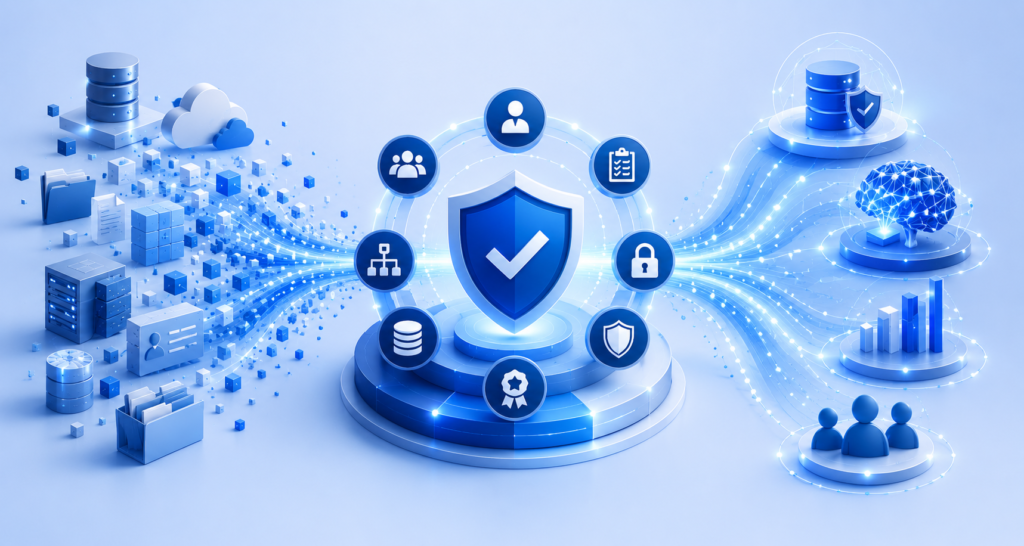
Data has become one of the most valuable assets in modern organizations. From customer insights and financial reporting to artificial intelligence and regulatory AI compliance. Nearly every business function depends on accurate, secure, and trustworthy data.
However, as data volumes increase and systems become more complex, many organizations struggle to maintain consistency, quality, accessibility, and compliance. This is where data governance frameworks become essential.
This guide explores the most widely used data governance frameworks, their core components, benefits, implementation strategies, and how organizations can select the right approach.
Data Governance Frameworks: The Direct Answer
Data governance frameworks are structured models that define how organizations manage, control, protect, and utilize data quality throughout its lifecycle.
A well-designed data governance framework establishes the policies, processes, roles, and standards required to manage data effectively across an organization. Without governance, data initiatives often suffer from poor quality, inconsistent definitions, compliance risks, and a lack of trust among business users.
These frameworks establish clear guidelines for:
- Data ownership
- Data quality
- Security and privacy
- Compliance
- Data access
- Metadata management
- Stewardship responsibilities
The purpose of a governance framework is to ensure that data remains accurate, secure, accessible, and aligned with business objectives. Rather than focusing solely on technology, data governance frameworks address people, processes, policies, and organizational accountability.
What Is a Data Governance Framework?
A data governance framework is a structured approach that guides how an organization manages its data assets. Whether an organization is implementing analytics, modernizing data infrastructure, or scaling AI initiatives, governance serves as the foundation that supports long-term success.
It provides a blueprint for establishing governance practices and maintaining consistency across departments, systems, and business processes.
The framework defines:
- Who owns the data
- Who can access it
- How it is managed
- How quality is maintained
- How compliance is enforced
- How issues are resolved
Without a governance framework, organizations often experience conflicting data definitions, inconsistent reporting, security vulnerabilities, and regulatory challenges.
Why Data Governance Frameworks Matter
Many organizations generate enormous amounts of data but lack the processes needed to manage it effectively. As a result, data becomes difficult to trust and even harder to use.
Several factors make governance increasingly important.
Growing Data Volumes
Modern businesses collect data from numerous sources including applications, cloud platforms, IoT devices, customer interactions, and operational systems. Managing this volume requires structured governance practices.
Regulatory Compliance Requirements
Organizations face increasing pressure to comply with regulations related to privacy, security, and data protection. Governance frameworks help establish accountability and control.
AI and Analytics Initiatives
Artificial intelligence and advanced analytics depend on high-quality data. Governance ensures that data remains accurate, reliable, and usable.
Cross-Functional Collaboration
Different departments often use the same data in different ways. Governance creates consistency across business functions.
Core Components of a Data Governance Framework
Although frameworks vary, most include several common components.
Data Ownership
Clear ownership is one of the most important aspects of governance. Data owners are responsible for defining standards, approving access, and ensuring accountability. Without ownership, governance initiatives often fail.
Data Stewardship
Data stewards manage the day-to-day implementation of governance policies.
Their responsibilities typically include:
- Monitoring quality
- Resolving issues
- Managing metadata
- Supporting compliance efforts
Stewards help ensure governance practices are consistently applied.
Data Quality Management
High-quality data is essential for business operations.
Governance frameworks establish standards for:
- Accuracy
- Completeness
- Consistency
- Timeliness
- Validity
Quality monitoring helps maintain trust in organizational data.
Policies and Standards
Policies define how data should be handled throughout its lifecycle. Standards create consistency across systems and departments. These guidelines support governance objectives while reducing ambiguity.
Metadata Management
Metadata provides information about data assets. Governance frameworks often include metadata strategies that improve discoverability, lineage tracking, and business understanding.
Security and Privacy Controls
Protecting sensitive information is a core governance responsibility.
Frameworks establish rules for:
- Access management
- Encryption
- Data classification
- Risk management
- Privacy protection
These controls help organizations reduce security and compliance risks.
Characteristics of an Effective Data Governance Framework
Frameworks that balance governance with operational efficiency tend to achieve the best outcomes. Successful frameworks share several important characteristics.
| Characteristic | Importance |
| Clear Ownership | Improves accountability |
| Business Alignment | Supports organizational goals |
| Scalability | Supports future growth |
| Flexibility | Adapts to changing requirements |
| Compliance Support | Reduces regulatory risks |
| Data Quality Focus | Improves trust and usability |
| Strong Communication | Encourages adoption |
| Executive Sponsorship | Drives organizational commitment |
Top Data Governance Frameworks Organizations Use Today
Several governance frameworks have emerged as industry standards. Each framework offers a different perspective on managing enterprise data.
DAMA-DMBOK Framework
The Data Management Body of Knowledge (DAMA-DMBOK) is one of the most widely recognized governance frameworks. Developed by the DAMA International, it provides comprehensive guidance for managing data as a strategic asset.
The framework covers multiple knowledge areas including:
- Data governance
- Data quality
- Metadata management
- Data architecture
- Data security
- Master data management
DAMA-DMBOK is particularly valuable for organizations seeking a comprehensive governance strategy.
Key Advantages
- Industry-recognized framework
- Comprehensive governance coverage
- Strong focus on data management best practices
- Applicable across industries
Potential Challenges
- Broad scope can make implementation complex
- Requires significant organizational commitment
COBIT Framework
The COBIT framework focuses on governance and management of enterprise information and technology. Although not exclusively designed for data governance, COBIT provides strong governance controls that support data management initiatives.
Organizations often use COBIT to align data governance with broader IT governance objectives.
Key Advantages
- Strong risk management capabilities
- Supports regulatory compliance
- Aligns governance with business goals
Potential Challenges
- Primarily IT-focused
- May require customization for data-specific requirements
DCAM Framework
The Data Management Capability Assessment Model (DCAM) was developed by the EDM Council. It provides a practical framework for assessing and improving data management maturity.
DCAM focuses on:
- Data governance
- Data quality
- Architecture
- Risk management
- Analytics readiness
Many financial institutions use DCAM to strengthen governance capabilities.
Key Advantages
- Maturity-based approach
- Practical implementation guidance
- Strong financial services adoption
Potential Challenges
- Assessment-focused rather than operationally prescriptive
- May require additional governance processes
CMMI Data Management Maturity Model
The Capability Maturity Model Integration (CMMI) framework helps organizations evaluate and improve data management practices. It provides structured maturity levels that guide continuous improvement.
Organizations can use the model to assess current governance capabilities and identify opportunities for advancement.
Key Advantages
- Clear maturity progression
- Supports continuous improvement
- Strong governance measurement capabilities
Potential Challenges
- Assessment process can be resource-intensive
- Requires long-term commitment
Hybrid Governance Frameworks
Many organizations do not follow a single framework exclusively. Instead, they combine elements from multiple models to address specific business requirements.
A hybrid approach allows organizations to:
- Adapt governance to unique environments
- Align with industry regulations
- Address operational priorities
- Support modernization initiatives
This flexibility is becoming increasingly common in large enterprises.
Comparing Popular Data Governance Frameworks
| Framework | Primary Focus | Best For | Complexity |
| DAMA-DMBOK | Enterprise data management | Comprehensive governance programs | High |
| COBIT | IT and information governance | Compliance and risk management | Medium |
| DCAM | Data management maturity | Financial services and assessments | Medium |
| CMMI | Process improvement | Governance maturity initiatives | Medium |
| Hybrid Models | Customized governance | Complex enterprise environments | Variable |
The right framework depends on organizational goals, industry requirements, and governance maturity.
How to Choose the Right Data Governance Framework
Selecting a framework requires evaluating business needs and operational challenges.
Assess Governance Maturity
Organizations should first understand their current governance capabilities. A maturity assessment helps identify strengths, weaknesses, and priorities.
Define Business Objectives
Governance initiatives should support measurable outcomes such as:
- Regulatory compliance
- Data quality improvement
- Analytics enablement
- AI readiness
- Risk reduction
Objectives should guide framework selection.
Consider Industry Requirements
Certain industries face unique governance obligations. Healthcare, financial services, and government organizations often require more stringent governance controls.
Evaluate Resource Availability
Some frameworks require greater investment in people, processes, and technology. Organizations should select an approach that aligns with available resources.
Data Governance Framework Implementation Steps
Successful implementation requires careful planning.
Step 1: Establish Executive Sponsorship
Leadership support is essential. Governance initiatives often span multiple departments and require organizational alignment.
Step 2: Define Governance Roles
Organizations should establish:
- Data owners
- Data stewards
- Governance councils
- Compliance teams
Clear accountability improves execution.
Step 3: Develop Policies and Standards
Governance policies should define how data is created, managed, accessed, and protected. Consistency is critical.
Step 4: Implement Governance Technology
Technology supports governance processes through:
- Data catalogs
- Metadata management
- Quality monitoring
- Access controls
- Lineage tracking
Tools improve efficiency and visibility.
Step 5: Monitor and Improve
Governance is not a one-time initiative. Organizations should continuously evaluate performance and refine governance practices.
Common Challenges in Data Governance Programs
Many organizations encounter obstacles during implementation.
Lack of Business Engagement
Governance is often perceived as an IT initiative. Without business participation, adoption may suffer.
Unclear Ownership
Governance responsibilities must be clearly defined. Ambiguity often leads to accountability gaps.
Resistance to Change
Employees may view governance as additional bureaucracy. Strong communication helps address these concerns.
Data Silos
Disparate systems make governance more difficult. Organizations often need broader data modernization efforts to support governance objectives.
Benefits of Implementing a Strong Data Governance Framework
Organizations that implement governance successfully often experience significant improvements.
| Benefit | Business Impact |
| Improved Data Quality | More accurate reporting and analytics |
| Better Compliance | Reduced regulatory risk |
| Enhanced Security | Stronger protection of sensitive data |
| Increased Trust | Greater confidence in data-driven decisions |
| Operational Efficiency | Reduced manual reconciliation efforts |
| AI Readiness | Higher-quality data for machine learning initiatives |
| Improved Collaboration | Consistent data definitions across departments |
These benefits contribute directly to business performance and strategic decision-making.
The Future of Data Governance Frameworks
Frameworks such as DAMA-DMBOK, COBIT, DCAM, and CMMI offer proven approaches for establishing accountability, improving data quality, and supporting business objectives. The best framework is not necessarily the most comprehensive.
Data governance continues to evolve alongside emerging technologies and business demands.
Several trends are shaping the future:
- AI-powered governance automation
- Real-time data quality monitoring
- Metadata-driven governance
- Data fabric integration
- Cloud-native governance platforms
- Privacy-first governance strategies
- Automated compliance monitoring
As organizations generate more data and adopt advanced analytics, governance will become even more important. Future frameworks will increasingly rely on automation to manage complexity at scale.
Final Thoughts: Data Governance Frameworks Create Trust in Data
Data governance frameworks provide the structure organizations need to manage data effectively in an increasingly complex digital landscape. Without governance, organizations struggle with inconsistent data, compliance risks, poor analytics outcomes, and limited trust in information.
As businesses continue investing in analytics, scaling AI initiatives, and digital transformation, governance will remain a critical capability for long-term success. If your organization is building a data governance program, modernizing its data ecosystem, or preparing for AI-driven transformation.
Data Pilot helps businesses design governance frameworks that improve trust, compliance, and enterprise-wide data value.