

For mid-market retail IT leaders, few phrases trigger as much anxiety as ERP migration. Ripping out a legacy Enterprise Resource Planning (ERP) system, such as an early deployment of Microsoft Dynamics, NetSuite, or an aging AS400, is a massive undertaking. These systems often house decades of custom business logic, localized pricing rules, and deeply ingrained operational workflows.
Replacing a core ERP is rarely a quick win. According to industry analysis, up to 75% of ERP replacement projects fail to meet their original objectives, often running significantly over budget and past deadlines. For retail operations, a botched migration means broken supply chains, stalled inventory syncs, and immediate revenue loss. You know your legacy system is a bottleneck for omni-channel growth, but the operational risk and capital expense of a full replacement are prohibitive.
The solution is not to rip and replace. The solution is to wrap.
The Concept of Wrapping Your Legacy ERP
Wrapping a legacy ERP means deploying API middleware and edge data layers around the existing system. Instead of altering the core code or ripping out the database, you build a modern bridge.
This API wrapper acts as a translation layer. It allows modern cloud applications, like your e-commerce storefront, Customer Data Platform (CDP), or Distributed Order Management (DOM) system, to communicate with the legacy ERP in real time. The wrapper extracts the necessary inventory, customer, and transactional data without disturbing the underlying architecture.
By treating the legacy ERP strictly as a backend system of record, you decouple it from the fast-moving front-end digital experience. This composable approach allows you to achieve modern omni-channel capabilities, such as real-time inventory visibility and unified customer profiles, while the legacy system continues to run the core accounting and warehouse functions it was originally built for.
API Wrapper Architecture: System Design
The following diagram illustrates how an API wrapper architecture connects your legacy on-premise systems to modern cloud platforms through a middleware translation layer.
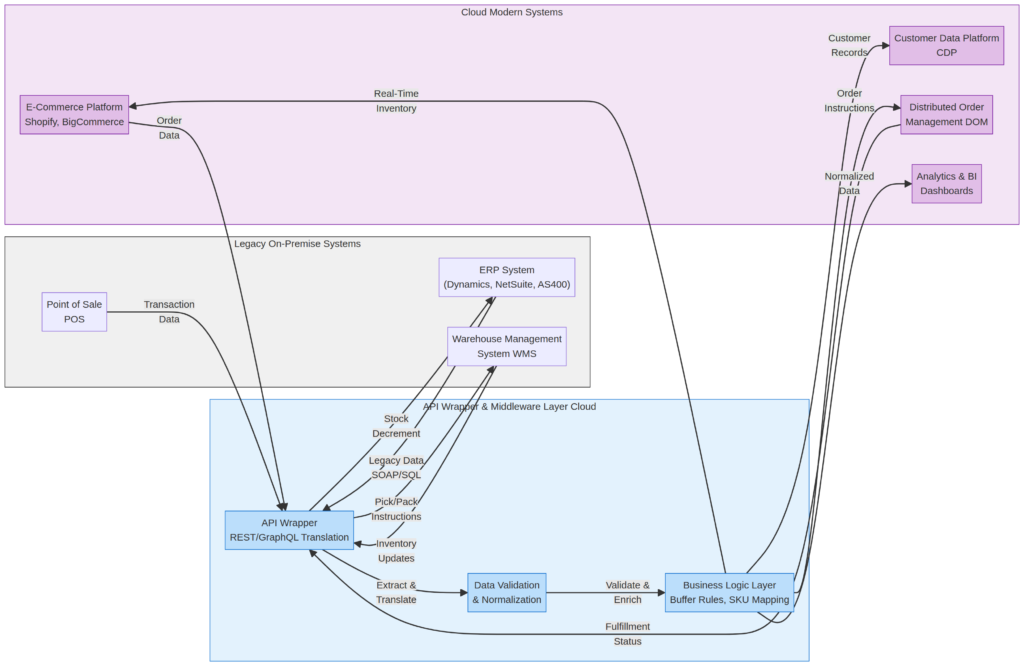
Key architectural components:
Legacy On-Premise Systems: Your existing ERP, Warehouse Management System (WMS), and Point of Sale (POS) systems remain unchanged. They continue to operate as systems of record for accounting, inventory, and transactions.
API Wrapper Layer: This is the bridge. The wrapper exposes your legacy system’s data through modern REST or GraphQL APIs. It translates legacy data formats (SOAP, direct SQL queries, proprietary protocols) into standardized payloads that cloud systems can consume.
Middleware & Validation Layer: The middleware applies business logic, data standardization, and enrichment. It normalizes SKUs, applies buffer stock rules, checks for data anomalies, and ensures compliance with your omni-channel requirements before data reaches the cloud.
Cloud Modern Systems: Your e-commerce platform, CDP, DOM, and analytics systems receive clean, real-time data. They operate independently of the legacy backend, allowing for faster iteration and modern customer experiences.
Technical Implementation Blueprint
Phase 1: API Wrapper Deployment (Weeks 1-4)
The first phase focuses on exposing your legacy system’s core functions through a modern API interface.
| Component | Specification | Rationale |
| API Protocol | REST with JSON payloads or GraphQL | Industry standard; easier for cloud systems to consume than legacy SOAP or proprietary formats |
| Authentication | OAuth 2.0 with API keys | Secure, industry-standard authentication for service-to-service communication |
| Data Format Translation | SOAP/SQL → REST/JSON | Bridges legacy data structures to modern cloud expectations |
| Rate Limiting | 1,000 requests/minute per endpoint | Prevents legacy system overload during high-traffic periods |
| Retry Logic | Exponential backoff (3 retries, max 30 seconds) | Handles transient failures without overwhelming the legacy system |
Deployment approach: Use a containerized API wrapper (Docker) deployed on a cloud provider or on-premise edge server. The wrapper queries the legacy database directly or connects via existing APIs. No changes to the legacy system code are required.
Phase 2: Middleware Validation & Business Logic (Weeks 5-8)
The middleware layer applies your specific business rules and data standardization.
| Business Logic | Implementation | Example |
| SKU Normalization | Map legacy SKU format to unified catalog schema | Legacy: “SHOE-BLK-10M” → Unified: “SKU-12345” with metadata |
| Inventory Buffer Rules | Apply dynamic safety stock thresholds per location | Hide last 2 units online if local store traffic is high; show all units during off-peak |
| Channel Mapping | Route data to correct e-commerce platform | Shopify orders go to Shopify fulfillment; Amazon orders to Amazon logistics |
| Data Validation | Reject malformed or incomplete records | Missing required fields trigger alert; record held for manual review |
| Compliance Checks | Ensure PII is hashed; audit logging enabled | Customer phone numbers hashed before CDP ingestion; all API calls logged |
Deployment approach: Middleware runs in your cloud data warehouse (Snowflake, BigQuery) or as serverless functions (AWS Lambda, Google Cloud Functions). It transforms raw API data into business-ready datasets.
Phase 3: Real-Time Data Flow Integration (Weeks 9-12)
Once the wrapper and middleware are operational, you establish bidirectional data flows.
Outbound flows (Legacy → Cloud):
- Inventory updates push to e-commerce platform every 5-15 minutes
- Customer transaction data flows to CDP for unified profiles
- Order data enriched with fulfillment location recommendations for DOM
Inbound flows (Cloud → Legacy):
- E-commerce orders trigger stock decrements in legacy ERP
- DOM routing decisions push pick/pack instructions to WMS
- Returns and cancellations reverse inventory in legacy system
Phase 4: Monitoring & Optimization (Weeks 13-16)
Establish observability and performance tuning.
| Metric | Target | Alert Threshold |
| API Response Time | <500ms (p95) | >1000ms triggers investigation |
| Data Freshness | <10 minutes | >15 minutes triggers alert |
| Error Rate | <0.1% | >0.5% triggers escalation |
| Legacy System CPU | <60% during peak | >75% triggers throttling |
Monitoring approach: Use cloud-native observability tools (DataDog, New Relic) to track API performance, data latency, and error rates. Set up automated alerts and dashboards for your operations team.
Operational Benefits of API Wrapping
Choosing to wrap rather than replace delivers immediate, measurable benefits to your retail operation.
Risk Mitigation: Because the core ERP code remains untouched, your daily operations, from payroll to warehouse receiving, continue without interruption. There is no go-live weekend where the entire business holds its breath.
Business Continuity During Deployment: You can modernize specific data flows iteratively. For example, you can wrap the inventory module first to solve online overselling and address the customer data module months later. Each phase delivers value independently.
Significantly Reduced Timelines: While a full ERP migration can take 18 to 36 months, an API wrapper can often be deployed and connected to a modern data layer in 8 to 16 weeks. This allows you to realize ROI in the same fiscal year.
Capital Efficiency: Wrapping extends the lifespan of your existing IT investments, freeing up capital to invest in revenue-generating customer experiences rather than back-office plumbing.
Technical Considerations & Trade-offs
Latency: API wrappers introduce a small latency overhead (typically 100-500ms per call). For real-time inventory, this is acceptable. For high-frequency trading or millisecond-critical operations, consider caching strategies.
Legacy System Load: Frequent API queries can increase load on the legacy system. Implement query optimization, caching layers, and rate limiting to prevent performance degradation.
Data Consistency: During the transition period, you may have data in both legacy and cloud systems. Establish clear ownership rules: which system is the source of truth for each data domain?
Scalability: As your e-commerce volume grows, ensure the API wrapper can handle increased query volume. Use horizontal scaling (multiple wrapper instances) or query optimization.
Map Your Legacy Architecture with Data Pilot
Modernizing your retail data architecture does not require risking your core operations. By deploying an API wrapper, you can unlock the omni-channel capabilities your customers demand while maintaining the stability your business requires.
However, not all legacy systems can be wrapped identically. The feasibility depends on your current database structure, existing API limits, data hygiene, and custom business logic embedded in the legacy system.
Ready to modernize without the migration risk? Book a discovery call with Data Pilot today. Our data engineers will audit your current architecture, map your legacy API limitations, evaluate your database schema, and determine the exact feasibility, timeline, and cost for wrapping your ERP. We’ll provide a detailed technical roadmap and implementation estimate specific to your retail operations.