
2026 won’t reward businesses that experiment with technology. It will reward the ones that commit.
For small and medium-sized businesses (SMBs), technology has officially moved out of the background. It’s no longer just keeping the lights on. It’s driving growth, efficiency, and smarter decisions. The era of trial-and-error is fading, and SMBs are getting serious about what actually works.
SMB tech predictions for 2026 point to a clear divide: businesses that use data, analytics, AI, and cloud tools with intention are pulling ahead, while those stuck with disconnected systems are falling further behind. The winners aren’t chasing every new tool. They’re focused on the few technologies that directly impact revenue, productivity, and decision-making. By connecting their data and aligning technology with business goals, these SMBs move faster, adapt quicker, and compete far beyond their size.
This article breaks down the SMB tech predictions for 2026 that will matter most and how to make sure your business ends up on the winning side of the gap.
AI Moves from Experiment to Everyday Tool
In 2026, AI won’t be just a separate tool or pilot project for SMBs. It will be built right into core systems like CRM, ERP, finance, marketing, customer support, and operations. Companies that embed AI into daily workflows rather than running it as a side project are more than twice as likely to see real financial benefits.
Gartner predicts that by 2026, over 80% of enterprise software will be multimodal, and this trend is quickly reaching mid-market businesses too. This means that the software can understand, process, and act on multiple types of inputs and outputs at once, not just text. For example, imagine a manager at work who needs to understand why sales dropped last week. Instead of digging through spreadsheets, reports, and emails separately, they upload a PDF report into the software and ask a simple question, like, “What are the key reasons, sales dropped last week?”
The software reads the document, checks the data, and creates a chart showing the answer. It can even suggest next steps, like creating a task for the team or sending an alert to management. All of this happens in one place, making it faster and easier to make smart decisions. This disperses the use of AI in everyday functions across the board.
What this means for SMBs:
a) AI will be a standard feature, not a special advantage
b) Success will come from using AI the right way, not just having it
c) Good data and strong governance will be essential
According to our AI experts, the winners in 2026 won’t be the ones experimenting with AI, they’ll be the ones using it every day to make better decisions, forecast accurately, and run their business smarter.
Analytics Evolves From Reporting to Decision Intelligence
Traditional dashboards only show what already happened. In 2026, SMBs will want analytics that help answer a more important question: What should we do next?
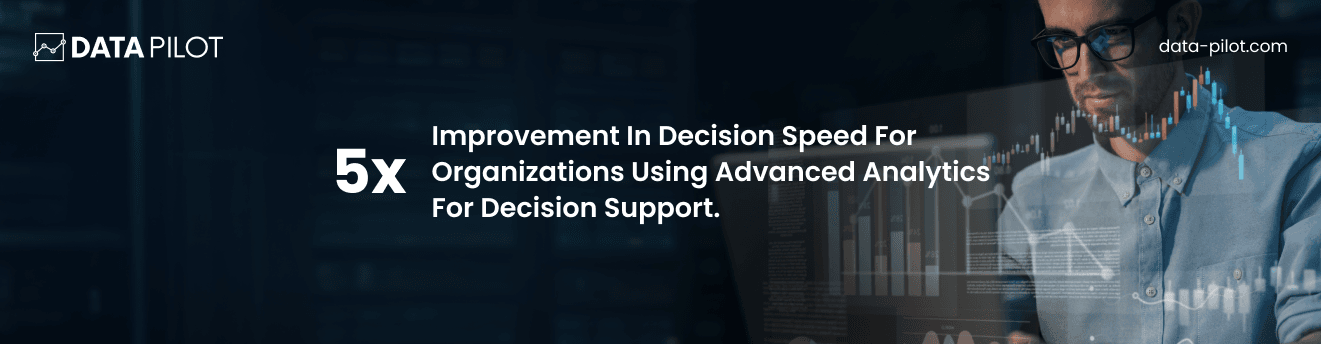
Predictive analytics tell you what to expect, while now, businesses are also using prescriptive analytics, which tell you what to do next. Tools like predictive and prescriptive analytics, which used to be only for large companies, are now becoming available to SMBs through modern BI tools, embedded analytics, and AI copilots. This move from basic reporting to predictive and prescriptive analytics is called decision intelligence and will help businesses stay competitive. A recent Forrester study shows that companies using advanced analytics can make decisions up to five times faster than those relying on basic reports.
What’s changing in 2026?
1) KPIs become triggers to do something next, not just metrics
2) Analytics outputs are tied to actions
3) Leadership expects insight and action, not charts
Also Read: How AI is Transforming Marketing Analytics from Gut Feelings to Data-Driven Precision
Cloud Strategy Shifts From Migration to Optimization
For most small and mid‑market companies, moving to the cloud is already something they’ve done. In 2025, many businesses focused on just getting their systems into the cloud. But by 2026, the big shift is happening: it’s all about using the cloud smarter, not just having it.
A lot of companies still waste a lot of money because they don’t really know what they’re spending or where their cloud resources are being used. That’s painful for mid‑market businesses with tighter budgets.
What’s changing in 2026?
a) FinOps becomes normal, not niche: Practices that help teams manage cloud costs–like forecasting, budgeting, and tagging–are becoming standard even in mid‑market firms. Teams that adopt these practices can cut waste and make their cloud spending work harder.
b) Hybrid and multi‑cloud setups settle in: Instead of all cloud workloads living in one place, companies are splitting work across different cloud providers and their own systems. Then, they are learning how to manage costs and performance across all of them.
c) Cloud investments get judged on ROI: Instead of patting themselves on the back for being “cloud‑first,” businesses are measuring how each cloud dollar drives real value by measuring aspects such as faster delivery, better performance, or cost savings.
Our experts say the competitive advantage in 2026 won’t come from being ‘cloud‑first,’ but from being cloud‑smart. Using cloud space wisely and spending every dollar with purpose is what’s important.
IT Transformation Becomes Business-Led
In 2026, leading small and mid‑market companies will stop thinking of IT as only an “IT thing.” CEOs, COOs, and CFOs are now stepping in because technology decisions affect growth, customer experience, and how well a company can handle challenges. Research from McKinsey shows that companies that align their technology plans with business goals tend to financially outperform their competitors quickly.
What’s changing in 2026:
a) IT roadmaps match business outcomes: Tech plans aren’t built in isolation. Every project is tied to clear business goals like sales growth or faster service.
b) Tech leaders are judged by impact: Rather than just keeping systems running, CIOs and CTOs are now evaluated on how much value their work brings to the company.
c) Teams share ownership across functions: Instead of only IT owning transformation, leaders and teams from all departments work together to make change happen.
What This Means for SMB Leaders in 2026
In 2026, the story isn’t about having the newest technology. it’s about using technology the right way. Across AI, analytics, cloud, and IT transformation, the winners won’t just adopt tools; they’ll execute smartly and consistently.
The biggest challenges now aren’t tech itself. They’re about:
a) Integration over fragmentation: Making different systems work together instead of adding more tools.
b) Outcomes over activity: Focusing on results, not activities.
c) Governance over chaos: Keeping processes and data under control so teams can act confidently.
What successful SMBs will do in 2026:
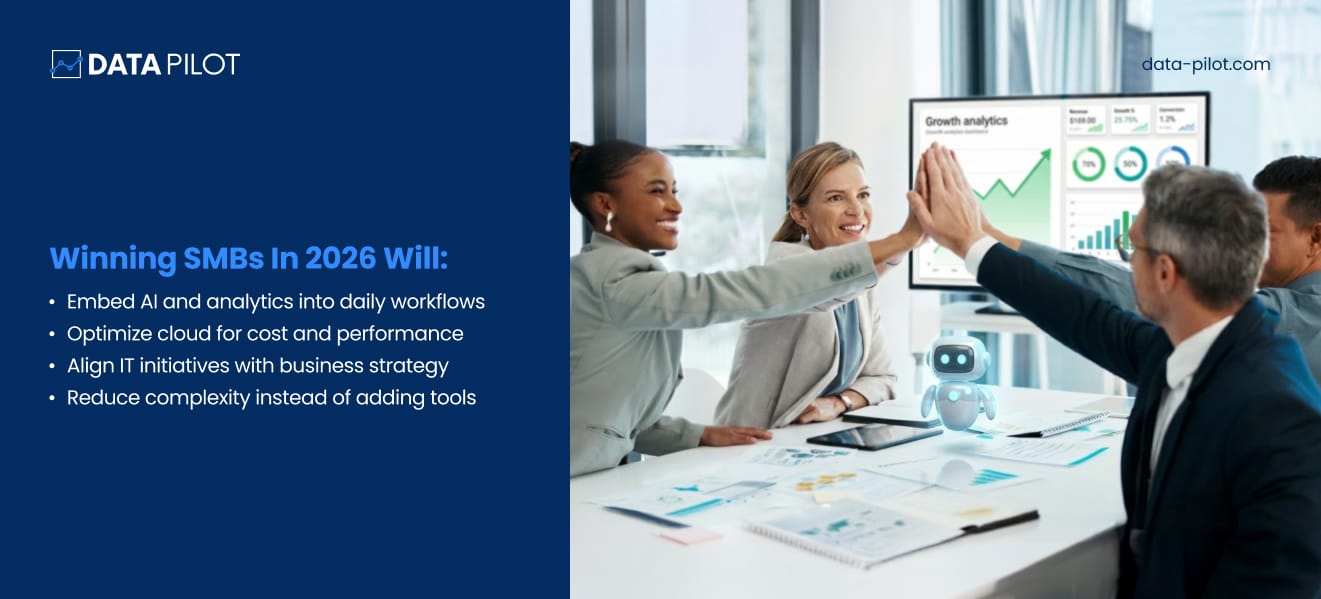
a) Embed AI and analytics into daily work: Think of smart tools that help employees make faster, better decisions every day.
b) Optimize cloud for cost and performance: Use the cloud efficiently and only pay for what’s needed and getting maximum speed and reliability.
c) Align IT projects with business goals: Every tech initiative should clearly support growth, customer experience, or efficiency.
d) Cut complexity instead of adding tools: Simplify systems so teams can focus on work that matters.
At Data Pilot, we see 2026 as the year companies stop chasing every new trend and start making technology truly work for the business.