

2026 is a defining year for data, analytics, and AI. While 2025 laid the foundation, this year shifts the focus from experimentation to agentic AI and responsible data governance. Organizations that master what’s new will pull ahead—while others face rising risk, complexity, and falling revenue.
If you are a business leader, CIO, or part of a data team, here are the key AI and data science trends for 2026 that you should be looking out for.
1. Agentic AI Moves from Experimentation to Execution
One of the biggest AI trends in 2026 is the rise of agentic AI. Agentic AI systems don’t just analyze or recommend, but act on their own. For example, an agentic AI system in revenue operations can monitor the status of leads in your pipeline in real time. It can then identify stalled deals. Next, it will begin targeted outreach, adjust lead-scoring models quickly, and update sales leadership. It can do all this without waiting for human prompts or manual intervention. To break it down, unlike traditional AI models, agentic AI can:
a) Set goals
b) Execute multi-step workflows
c) Interact with multiple systems and continuously adapt based on outcomes
Agentic AI shifts AI from a decision-support tool to an operational participant. Satya Nadella, CEO of Microsoft says, “AI agents will become the primary way we interact with computers in the future. They will be able to understand our needs and preferences and proactively help us with tasks and decision-making.”
What Nadella is saying here is that this is a shift from reactive AI that responds to prompts like ChatGPT to proactive AI which anticipates needs and acts on its own without human intervention. In practice, it means less manual work, faster decision cycles, and humans focusing on judgment and strategy rather than repetitive tasks. For those who are concerned about whether it means they will be replaced, the short answer: Not necessarily.
AI will be handling execution and coordination. But agentic AI isn’t about replacing people. It’s about redesigning how work gets done. But there is a catch. Agentic AI also introduces new governance, accountability, and risk considerations.
Organizations adopting agentic AI must ensure
1) Clear guardrails: Define what the AI can and cannot do, with clear boundaries based on business risk and compliance.
2) Auditability: Ensure every action, decision, and data input is traceable, explainable, and reviewable.
3) Thorough oversight: Maintain human-led governance to monitor performance and intervene when needed.
2. Responsible AI and Data Governance Become Non-Negotiable.
As AI becomes more autonomous, responsible AI and data governance move from “best practice” to an operational necessity.
In 2026, organizations are prioritizing:
a) Clear data ownership and stewardship
b) Explainable AI decisions
c) Bias detection and mitigation
d) Audit trails for AI-driven actions
e) Compliance with evolving data privacy regulations
AI systems are only as trustworthy as the data and rules behind them. Without governance, AI introduces compliance risk, reputational damage, and operational uncertainty. Strong data governance is no longer preventing innovation. It’s what enables safe, scalable AI adoption.
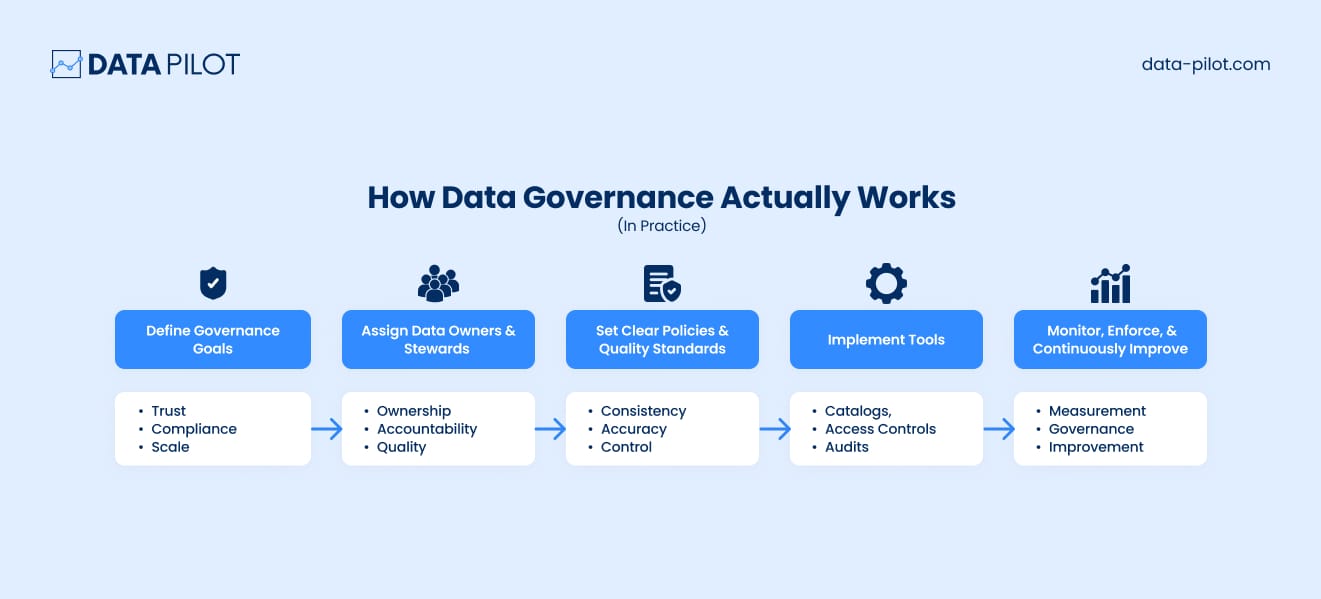
At an executive level, data governance is a risk and value multiplier. Gartner estimates that poor data quality costs organizations an average of $12.9 million per year, making governance necessary to protect revenue and speed up decision-making. Strong governance turns data into a strategic asset leaders can trust at scale.
3. Analytics Shifts From Reporting to Decision Intelligence
Traditional dashboards and static reporting are no longer enough. AI and data science trends 2026 see analytics evolving into decision intelligence. Now, businesses combine data, context, AI, and business logic to support real-time action.
Key developments include:
1) Embedded analytics inside workflows
2) Real-time and predictive insights
3) Complete measurement (data → action → outcome)
4) AI-powered anomaly detection and recommendations
This is important because organizations need insights that answer, “What should we do next,” not “What happened?” These are prescriptive analytics tools.
About 19% of enterprises have adopted prescriptive analytics tools that not only forecast outcomes but recommend actions to take next. This is a clear shift from traditional descriptive or predictive models that tell you what is happening and what is likely to happen next.
Also Read: Business Intelligence vs Data Analytics: A Guide to Making Data-Driven Decisions
4. Data Quality and Integration Become AI Enablers
More AI doesn’t fix bad data. In fact, it amplifies it. In 2026, high-performing organizations are investing heavily in:
- Unified data pipelines to keep all their data flowing smoothly from where it’s created to where it’s used.
- Master data management (MDM), which involves having one “single truth” for important things like customers, products, and accounts.
- Metadata management to know what data they have, where it came from, and how it’s used.
- Automated data quality checks to instantly spot and fix mistakes or messy data.
- Cross-platform integration to connect all their tools and systems so data can move from one platform to another.
As emphasized before, AI models trained on fragmented or inconsistent data produce unreliable outcomes, regardless of model sophistication. Clean, connected, and well-documented data is the starting point for AI and analytics.
5. AI and Analytics Become Embedded Across the Business
AI and analytics are no longer confined to data teams. In 2026, they are becoming embedded across marketing, operations, finance, and IT. According to industry research, 78% of organizations used AI in at least one business function in 2024, up from 72% in 2022. This shows that AI is no longer just being tested, but is now part of daily work across teams like marketing, finance, and operations.
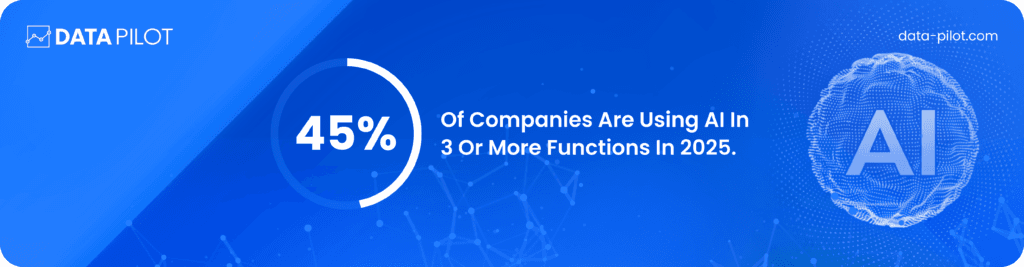
Adoption isn’t only superficial: In 2025, 45% of companies are using AI in three or more functions, and 2026 is likely to show an upward trend. The AI bubble may have deflated very minutely for those pessimistic about its application in 2025, but it has nowhere near popped.
6. Governance-First Architecture Becomes the Default
As companies rely more on data to make decisions, many are now building data systems with governance in place from the start. Instead of adding rules later, they design platforms with security, compliance, and clear controls built in. This helps keep data accurate, trustworthy, and easy to track, while also making it faster to use AI and analytics.
According to WifiTalents, 80% of organizations believe data governance is critical to their operational success. By focusing on governance early, businesses can grow their data efforts without creating silos, reduce risk, and turn data into a real advantage that supports innovation and better business results.
Preparing for 2026: What Organizations Should Do Now
According to AI and data science trends 2026, to stay competitive, organizations should focus on:
- Strengthening data governance and stewardship
- Modernizing data integration and analytics pipelines
- Embedding responsible AI principles into strategy
- Preparing for agentic AI with clear controls and oversight
- Shifting analytics from reporting to decision enablement
At Data Pilot, we help organizations build the data foundations, governance frameworks, and analytics capabilities needed to adopt AI responsibly and at scale.