
Managing data in the cloud is not the same problem it was five years ago.
Organizations now operate across multiple cloud providers, dozens of data sources, and distributed teams that need consistent, trustworthy access to data at scale.
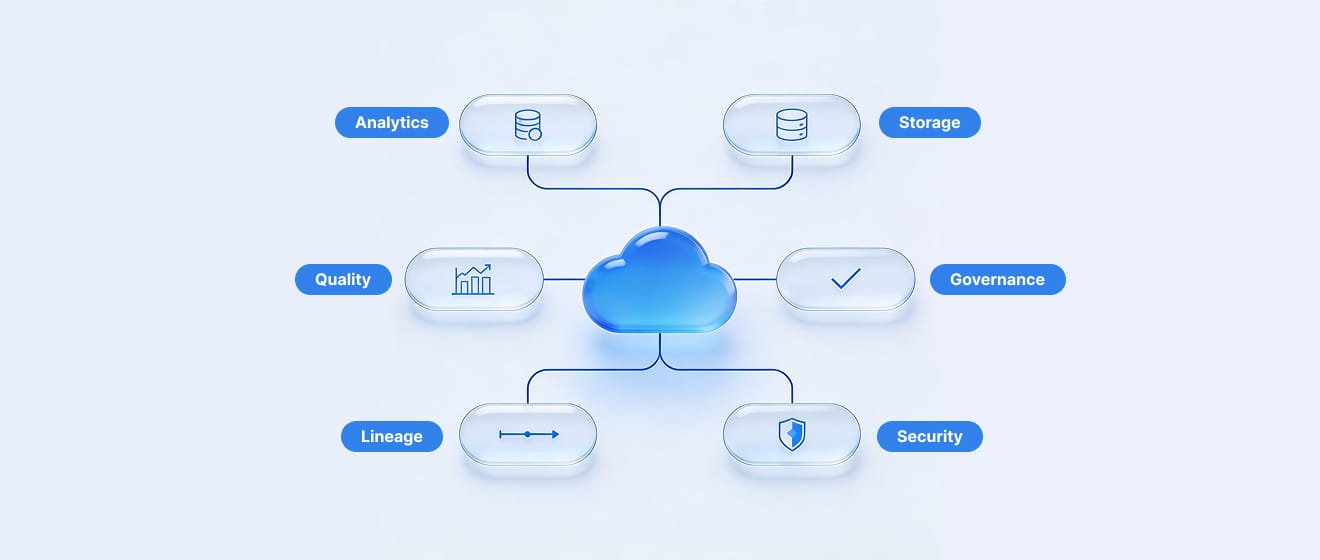
A single cloud data management platform that unifies ingestion, governance, quality, and analytics has become the operational backbone modern data strategies depend on.
This guide explains what a cloud data management platform is, what capabilities actually matter when evaluating one, how the leading platforms compare in 2026, and what to look for before you commit to a vendor.
What Is a Cloud Data Management Platform? The Direct Answer
A cloud data management platform is a system that manages the full lifecycle of organizational data across cloud environments.
That lifecycle runs from ingestion and storage through transformation, governance, quality management, and analytics delivery.
It is the connective tissue between your data sources and the teams and systems that need to use that data reliably.
The definition has expanded significantly.
Early cloud data management focused narrowly on storage and ETL.
Today, a cloud data management platform is expected to handle data integration across hybrid and multicloud environments, enforce governance policies centrally, maintain data quality at scale, provide lineage tracking for compliance and AI readiness, and support self-service access for business users without requiring engineering involvement for every query.
In practical terms, it is the platform that determines three things:
- How much engineering overhead your data operations carry.
- How consistently your metrics are defined across the organization.
- How quickly you can respond to a regulatory audit or a data quality incident at 2am.
Why Cloud Data Management Has Become a Strategic Priority
Three converging forces have elevated cloud data management from an IT concern to a board-level priority.
First, data volumes have outgrown traditional management approaches.
Organizations now ingest data from cloud applications, IoT devices, customer platforms, third-party APIs, and legacy systems simultaneously.
Manual data preparation and siloed pipelines cannot keep pace with this volume or diversity.
Second, AI readiness has made data quality non-negotiable.
Training machine learning models and deploying AI applications requires clean, well-governed, consistently labeled data at scale.
Organizations that cannot deliver this are building AI on foundations that will produce unreliable outputs. They typically discover this problem after significant investment, not before.
Third, regulatory complexity has increased.
GDPR, CCPA, HIPAA, and sector-specific mandates require organizations to demonstrate data lineage, enforce access controls, and respond to data subject requests within defined timeframes.
Organizations without centralized cloud data management struggle to meet these obligations consistently.
Core Capabilities of a Cloud Data Management Platform
Feature lists across vendors look similar. Integration, governance, quality, security, and scalability appear on every product page.
The meaningful differentiation lies in how well each capability is implemented and how well it holds up at enterprise scale.
Data Integration and Ingestion
The platform must connect to all sources relevant to your environment.
Sources include cloud data warehouses, operational databases, SaaS applications, streaming data sources, and legacy on-premises systems.
The depth of native connector libraries varies significantly.
Platforms with comprehensive certified connectors reduce the engineering overhead of keeping integrations functional as source systems update.
Those requiring custom connector development introduce ongoing maintenance costs that compound over time.
Modern platforms support both batch and real-time data ingestion.
As operational analytics use cases grow, real-time ingestion capability has moved from a nice-to-have to a baseline requirement.
These are use cases where decisions need to be made on current data rather than yesterday’s batch.
Data Governance and Policy Enforcement
Governance in a cloud environment means enforcing consistent data policies across decentralized teams working across dozens of tools and cloud services.
A cloud data management platform should allow organizations to define access controls, data classification rules, retention policies, and usage constraints centrally.
It should enforce them consistently regardless of whether the data is stored in Snowflake, Amazon S3, or an on-premises Oracle instance.
This centralized enforcement model is what distinguishes a genuine cloud data management platform from a collection of governance tools bolted onto individual data stores.
Without it, governance becomes a documentation exercise rather than a control mechanism.
Data Quality Management
Data quality management covers the detection, measurement, and remediation of data quality issues across the data lifecycle.
This includes profiling data at ingestion, applying validation rules, monitoring quality metrics over time, and triggering alerts or remediation workflows when quality thresholds are breached.
Quality management is particularly critical for AI and analytics workloads.
A model trained on data with systematic quality issues produces systematically biased outputs.
By the time this is discovered in production, the cost in both business decisions and remediation effort is substantially higher than catching the quality issue at source.
Data Lineage and Metadata Management
Data lineage tracks where data originated, how it was transformed, and where it flows through the organization.
In a cloud environment, this spans two dimensions:
- Technical lineage: Which systems and pipelines data moves through.
- Business lineage: How data relates to business processes, metrics, and definitions.
Lineage visibility has become essential for three reasons:
- Compliance audits require organizations to demonstrate the provenance of data used in regulated processes.
- AI model governance requires understanding what training data was used and how it was prepared.
- Operational incident response requires the ability to trace a data quality issue back to its source quickly.
Scalability and Multicloud Support
Enterprise data environments rarely operate on a single cloud.
Most large organizations run workloads across AWS, Azure, and GCP simultaneously, either by design or through acquisition.
A cloud data management platform must support multicloud deployment without requiring separate governance frameworks, duplicate data copies, or inconsistent policy enforcement for each cloud environment.
Scalability extends beyond storage volume.
The platform must handle diverse workloads consistently as user counts and data volumes grow. That includes batch analytics, real-time event processing, and AI and ML training.
Platforms that perform well in proof-of-concept deployments at small scale but degrade under enterprise production conditions are a common and expensive discovery.
Security and Compliance Controls
Role-based access control (RBAC), encryption at rest and in transit, audit logging, and data masking are baseline requirements.
The more demanding dimension is compliance with sector-specific and regional regulations.
The platform must support automated enforcement of retention policies, data subject access rights, and cross-border data transfer restrictions.
Security controls that require manual configuration for each new data source or user group create operational overhead.
That overhead scales against the organization as data volumes and team sizes grow.
Platforms that apply governance policies automatically as new sources are connected and new users are provisioned reduce this overhead significantly.

Leading Cloud Data Management Platforms in 2026: How They Compare
The platform landscape in 2026 is dominated by a small group of well-capitalised vendors.
Each has a distinct architectural philosophy.
The right platform depends on your existing technology stack, your team’s technical profile, and the workloads you need to support.
| Platform | Architecture | Primary Strength | AI and ML Maturity | Best Fit |
| Snowflake | Cloud-native; separated storage and compute | SQL analytics, data sharing, governance | Growing (Cortex AI, Snowpark) | Enterprise SQL analytics; multicloud with governance priority |
| Databricks | Lakehouse (Delta Lake plus Apache Spark) | Large-scale data engineering and AI and ML | Market-leading (MLflow, Unity Catalog) | AI-heavy workloads; data engineering teams with Spark experience |
| Microsoft Fabric | Unified SaaS; OneLake storage layer | Integrated analytics and BI in one platform | Strong (Azure ML, Copilot integration) | Microsoft or Azure-centric organizations; unified platform preference |
| Google BigQuery | Serverless cloud data warehouse | Serverless query performance, GCP-native | Strong (Vertex AI integration) | GCP-native organizations; cost-sensitive; serverless priority |
| Informatica IDMC | Microservices; cloud-native modules | Data governance, quality, and MDM depth | Moderate (AI-assisted cataloging) | Large enterprise with full data governance and MDM requirements |
In 2026, the lines between these platforms are blurring.
Snowflake is expanding aggressively into AI. Databricks has matured its SQL warehouse to compete directly with Snowflake on analytical workloads.
Microsoft Fabric is driving toward a unified SaaS experience that eliminates integration overhead between data engineering, warehousing, and reporting.
Many large enterprises now adopt multi-platform strategies rather than forcing all workloads onto a single vendor.
A common pattern is Databricks for data engineering and AI, Snowflake for the analytical warehouse, and Power BI through Fabric for reporting.
Cloud vs On-Premises Data Management: What Has Actually Changed
| Dimension | On-Premises | Cloud Data Management Platform |
| Infrastructure | Organization manages hardware, patching, capacity planning | Vendor-managed; elastic scaling on demand |
| Upfront cost | High CapEx for hardware and licensing | Low or no CapEx; OpEx consumption model |
| Scalability | Limited by physical hardware; slow to expand | Horizontal scaling across distributed environments |
| Governance enforcement | Manual per-system configuration | Centralized policy enforcement across all connected sources |
| AI and ML readiness | Requires significant additional infrastructure | Native integration with AI frameworks and model training |
| Multicloud | Not applicable | Native support for AWS, Azure, GCP simultaneously |
| Disaster recovery | Complex; requires dedicated DR infrastructure | Automated backups; high availability built in |
Also Read: Practical Steps to Make Your Cloud Migration Journey Simpler
Key Challenges in Cloud Data Management
Migrating to and operating a cloud data management platform is not without friction.
The organizations that struggle most are those that treat platform selection as the solution rather than as the enabler.
Migration complexity: Moving years of accumulated data (legacy formats, undocumented schemas, interdependent pipelines) to a cloud environment is a significant program of work. A phased migration with clear prioritization of critical workloads is consistently more successful than big-bang approaches.
Egress costs: Organizations that did not plan for data egress fees at the start of cloud deployments routinely discover budget overruns. Nearly two-thirds of organizations reported unexpected egress charges in their cloud data environments in 2025. (Source: Flexera, “State of the Cloud Report 2025,” flexera.com/state-of-the-cloud) Query patterns, replication strategies, and multicloud architectures all need to be evaluated for egress implications before commitments are made.
Governance without discipline becomes documentation: A cloud data management platform provides the tools for governance. It does not impose governance. Organizations that deploy governance tooling without the organizational processes, data ownership models, and accountability structures to back it up end up with well-documented data problems rather than managed ones.
Vendor lock-in: Proprietary storage formats, query engines, and API dependencies create switching costs that compound over time. Platforms that support open standards like Apache Iceberg, Delta Lake, and Parquet reduce this risk considerably.
Skill gaps: Effective use of enterprise cloud data management platforms requires skills that are scarce. Deployment timelines and operational efficiency depend heavily on whether the organization has, or can hire, the people to manage what the platform provides.
How to Choose a Cloud Data Management Platform
The evaluation question is not which platform has the most features.
It is which platform’s strengths align most closely with your actual requirements, and whose failure modes are most recoverable given your team’s capacity.
Start With Your Tech Stack, Not the Feature Matrix
If your organization is heavily invested in Microsoft Azure and Microsoft 365, Microsoft Fabric deserves serious evaluation before any others.
If your data engineering team runs Spark and your roadmap includes custom ML models, Databricks is the natural starting point.
Platform selection that ignores existing technology investments typically creates integration overhead that erodes the efficiency gains the platform was meant to deliver.
Evaluate the Metadata Layer Honestly
How well does the platform capture and maintain context about data?
Context includes its origin, its transformations, its relationships, and its known quality issues, in a form that is actually usable by the people who need it.
Data without context is storage. The metadata layer is what turns storage into a managed asset.
This dimension is most often underweighted in procurement and most often regretted in production.
Assess Operational Overhead Realistically
Every platform creates work: configuration, monitoring, maintenance, incident response, and version management.
The question is whether that work is distributed sensibly or concentrated in a small team that becomes a bottleneck.
Request reference customers from the vendor who are running at the scale and complexity you are planning for, not the scale you are starting from.
Plan for Multicloud From the Start
Over 70 percent of enterprises now operate hybrid or multicloud data environments. (Source: HashiCorp, “State of Cloud Strategy Survey 2024,” hashicorp.com/state-of-cloud-strategy; corroborated by Flexera, “State of the Cloud Report 2025,” flexera.com)
Even organizations that start single-cloud rarely stay that way. Change comes through acquisition activity, regulatory requirements, or strategic shifts.
Platforms that enforce consistency of governance, lineage, and access control across cloud environments reduce the technical debt that accumulates when each cloud deployment evolves independently.
Run a Scoped Proof of Concept on Your Actual Workloads
Vendor demos are optimized for vendor demos.
The proof of concept engagement should connect to your actual data sources, run your actual query patterns, and involve the team members who will maintain the platform after going live.
Discoveries made in a PoC are cheap. Discoveries made 12 months into a production deployment are expensive.
Final Thoughts: The Platform Is the Foundation, Not the Strategy
A cloud data management platform is a necessary but not sufficient condition for effective data management.
The organizations that extract the most value from these platforms are the ones that arrived with clear data strategy, defined governance processes, and organizational accountability for data quality before they signed a vendor contract.
The platform provides the infrastructure for governance, quality, and analytics at scale. It does not provide discipline.
Organizations that invest in a platform without investing in the governance framework and the people to operate it consistently find themselves with an expensive and underutilised tool within 18 months.
If you are assessing platforms, evaluating your current data maturity, or building the business case for a cloud data investment, that is the conversation to start with.
Data Pilot’s strategy consulting is designed to help data teams answer those questions before the budget is committed to the wrong platform. Book your free consultation now!