
 Every company says, “We’re data-driven,” but the question actually is whether you are using data properly. Consider, who owns the data? Who checks if it’s correct? Who decides who can access it? What happens when it’s wrong? And suddenly all you will hear is silence.
If your data architecture lacks data governance, you are at risk. Data governance is about making sure data is accurate, secure, consistent, usable, and trusted. Without it, dashboards can be inaccurate, and reports can conflict. As a result, teams can argue, and decisions slow down. Let’s walk through the top data governance frameworks: what they are, who they’re for, and when to use them.
What Are Data Governance Frameworks?
Think of data governance frameworks as a blueprint. They answer specific questions. Who owns the data? Who manages it? How is it defined? How is it protected? And how is it used? A good framework gives you:
- Policies and standards – Rules that define how data should be managed, stored, and used.
- Roles and responsibilities – Clear ownership of data (e.g., data owners, data stewards, governance committees).
- Data quality management – Processes to ensure data is accurate, consistent, and reliable.
- Access and security controls – Guidelines on who can access data and under what conditions, including the implementation of user authentication, role-based access controls, and regular audits to ensure compliance with these guidelines.
- Compliance and regulatory alignment – Ensuring data practices meet legal and industry regulations.
Without a framework, governance becomes random, while having one makes governance repeatable. Also, without a framework, data becomes inconsistent, and unreliable, sensitive information can be exposed, and teams may be working with different versions of the data. This can lead to compliance penalties for companies. Let’s look at some of the most popular frameworks.
DAMA-DMBOK
The DAMA International framework is called DMBOK, which stands for Data Management Body of Knowledge. It sounds intimidating, but it’s really just a complete guide to managing data across an organization. The framework outlines best practices, principles, and processes for managing data across its entire lifecycle, from creation and storage to usage and retirement. It may be difficult to understand how it is just a guideline for setting up data governance and what that means. Picture your company as a library. The library has many books, different sections, librarians, rules for borrowing, and people who need information quickly. Now, let’s assume some books are in the wrong section and some have missing pages. There are no labels and some are duplicated. Plus, no one knows who will handle them or who is responsible for them. It would take forever to find the right book. DAMA-DMBOK is a guide that tells you how to manage your data properly. The next framework is about how to manage technology, while DAMA-DMBOK is about managing information. It helps you ensure your information is clean, organized, safe, and useful.
What It Covers
DMBOK looks at data from every angle:
- Data governance
- Data quality
- Data architecture
- Metadata management
- Data security
- Master data management
It’s used to improve data quality and consistency, ensure compliance and security, and clarify ownership and accountability. It enables data-driven decision-making and treats data as a strategic asset
Who Uses It and When to Use It
The DAMA-DMBOK is essentially the operating manual for enterprise data management, helping organizations govern, structure, secure, and use their data effectively. Use DAMA-DMBOK if:
- You’re building governance from scratch
- You want a formal, structured approach
- You’re in a regulated industry
- You need enterprise-wide alignment
It’s used in industries such as finance, healthcare, pharmaceuticals, government, and large enterprise technology firms. However, If you are under regulatory pressure and want to benchmark data maturity, you may want to use the DCAM.
| If you need | Choose |
|---|---|
| A foundational blueprint for enterprise data governance | DAMA-DMBOK |
| A way to assess and benchmark maturity | DCAM |
| A common vocabulary across teams | DAMA-DMBOK |
| A regulatory-grade capability model | DCAM |
The Downside
The DAMA-DMBOK is comprehensive and vast, which often makes it intimidating and overwhelming. Overall, it provides a foundation, but lacks strategic implementation guidance. So, it is heavier on theory but isn’t as prescriptive or self-explanatory on the implementation side. For fast-moving companies, it may feel less agile. Basically, use it as a foundation when you are building your governance model, but use other frameworks to go deeper into implementation. Check out our DAMA-based free data assessment below. 👇

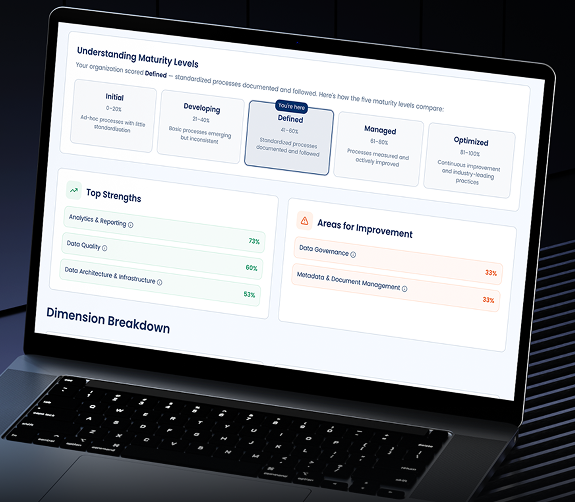
10 Minutes to Total Data Clarity
Stop the guesswork. Get an instant snapshot of your data maturity across 5 DAMA pillars and see exactly where you stand.
COBIT
Next up is the Control Objectives for Information and Related Technologies ( COBIT) developed by ISACA. The framework is not a traditional data governance framework but is designed to manage enterprise IT. Basically, it ensures that IT manages business objectives while supporting compliance, risk, and performance. Let’s break this down into child-like simplicity. Imagine that your company is a school. The school has computers, files, passwords, teachers on IT teams, rules, and a principal who acts as the leader. Now, let’s assume no one knows which computer they can use, who can see which files, the procedure if something breaks, who fixes what problem, and how to protect your data from outsiders. COBIT is a rulebook that tells you how to run your company’s technology properly and helps you govern all these aspects.
What It Covers
COBIT is strong in:
- Risk management
- Compliance
- Control systems
- IT alignment with business goals
It answers whether you are managing information responsibly. It also answers who is responsible for our tech assets? How do we keep data safe? How do we manage risk and how do we align IT with the goals of the rest of the business?
Who Uses It and When to Use It
COBIT works best when:
- You’re in finance, healthcare, or government
- Compliance matters a lot
- You need strong audit trails
- Your IT department drives governance
| Category | COBIT | DAMA-DMBOK |
|---|---|---|
| Primary Focus | IT governance and control | Data management and governance |
| Developed By | ISACA | DAMA International |
| Core Objective | Ensure IT supports business goals while managing risk | Ensure data is accurate, secure, and well-managed across its lifecycle |
| Scope | Enterprise IT processes, risk, compliance, performance | Data governance, quality, architecture, metadata, MDM, BI |
| Approach | Control-driven and compliance-oriented | Knowledge-based and principle-driven |
| Strength | Strong for audit, regulatory alignment, and risk management | Strong for data quality, stewardship, and data strategy |
| Best For | Organizations needing IT oversight and regulatory compliance | Organizations building structured data governance programs |
| Weakness | Less depth in data-specific disciplines | Less prescriptive on implementation and measurement |
The Downside
It can feel very beuracratic and heavy because it has alot of rules, controls, and documentation. If your goal is culture change and data ownership across departments, COBIT alone may not be enough. It’s focused on managing technology rather than messy data, inconsistent definitions, and poor data quality, It also may not be ideal for startups or SaaS companies as it is vast and may feel overwheleming. Howevr, if you are in big regulated industires, it suits your needs.
DCAM
The Data Capability Assessment Model (DCAM) is designed to strengthen a company’s data management capabilities. It’s developed by the EDM Council. It’s not limited to what good management looks like but extends to measure how mature your data management actually is. It looks at gaps, risks, opportunities, and helps leaders make strong decisions regarding strategy, governance, and improvements. The core of the framework considers data to be a strategic asset and covers particular areas such as data govnernance, data quality, architecture and integration, regulatory compliance and risk management, and provides metrics and performance data to assess how well your data management processes are helping business outcomes. Let’s simplify what this model does. So, in this scenario, imagine your company is a gym. You are interested in knowing how strong are we? Where are our weaknesses? Where should be improve? Are our capabilities mature? The DCAM is like a fitness assessment. It tells you how mature your data management is and what level you are operating at. So the DAMA-DMBOK gives you guidelines on how to do it and DCAM measure how well you are doing it.
What It Covers
DCAM focuses on capabilities. It asks: “How mature is our data management?” It breaks governance into measurable areas like:
- Data ownership
- Data quality control
- Architecture alignment
- Issue resolution
You can score yourself. Accordingly, you figure out where you stand today in terms of data maturity, what gaps exist, and what needs improvement.
Who Can Use it and When to Use It
The DCAM is great for:
- Large enterprises
- Financial institutions
- Organizations that want measurable maturity levels
| Category | DAMA-DMBOK | COBIT | DCAM |
|---|---|---|---|
| Full Name | Data Management Body of Knowledge | Control Objectives for Information and Related Technologies | Data Management Capability Assessment Model |
| Developed By | DAMA International | ISACA | EDM Council |
| Primary Focus | Data management and governance | IT governance, risk, and compliance | Assessing data management maturity |
| Scope | Data governance, quality, architecture, metadata, master data, BI, lifecycle management | IT processes, risk management, controls, compliance, performance | Data governance, quality, architecture, risk, metrics, regulatory readiness |
| Core Objective | Provide a comprehensive framework and blueprint for managing data | Ensure IT systems support business goals while controlling risk | Measure current capabilities and identify gaps in data management |
| Approach | Knowledge- and principle-driven | Control- and compliance-driven | Assessment- and benchmarking-driven (scorecard) |
| Strengths | – Holistic data guidance – Standardizes terminology – Focused on quality, stewardship, and lifecycle | – Strong for audits, compliance, and IT risk – Clear control framework – Regulatory alignment | – Provides measurable maturity – Excellent for regulated industries – Identifies gaps and improvement roadmap |
| Weaknesses | – Less prescriptive on implementation – Can feel academic or complex – Not a scorecard | – IT-centric; less depth in data-specific disciplines – Can feel bureaucratic – Less flexible for agile environments | – Focused on assessment, not detailed implementation – Enterprise-heavy – Time/resource-intensive – Compliance-oriented |
| Best For | Organizations building structured data governance programs and data strategy | Organizations needing IT oversight, audit readiness, or regulatory compliance | Organizations needing to benchmark data maturity, assess risks, and create improvement plans |
| Key Difference | Provides a blueprint for what good data management looks like | Governs IT systems and processes broadly | Measures how good your data management actually is |
The Downside
DCAM is great for benchmarking data management maturity and helping you be regulatory-ready but it may be considered enterprise-focused and heavy for some. It’ time and resource-intensive and tells you where you are, but not how to get better and that too quickly.
The Data Governance Institute (DGI) Framework
The Data Governance Institute (DGI) framework is simpler and more accessible. DGI feels like a practical handbook that answers questions like who owns the data, who is allowed to use it, how do we keep it accurate, and how do we protect sensitive information? It’s less comprehensive than DAMA but can help build solid data governance foundations. Let’s assume your company’s data is a city. The city needs traffic rules, street signs, police, city planners, and clear responsibilities. The DGI is the planner that provides guidance on who owns the data, who can use it and how they can use it, how to keep it accurate and secure, and how to make decisions and keep your team accountable towards them.
What It Covers
It organizes governance into:
- Rules and decision rights
- People and responsibilities
- Processes and controls
It emphasizes clarity in:
- Who decides
- Who enforces
- Who monitors
In short, DGI ensures that data is trusted, secure, and usable, while clearly defining who is responsible for it and how it should be managed.
Who Can Use It And When to Use It
Good for:
- Mid-sized companies
- Teams just starting governance
- Organizations needing clear role definitions
| Category | DGI (Data Governance Institute) | DAMA-DMBOK |
| Full Name | Data Governance Institute Framework | Data Management Body of Knowledge |
| Developed By | Data Governance Institute | DAMA International |
| Primary Focus | Practical framework for implementing data governance in organizations | Comprehensive guide to all aspects of data management |
| Scope | Data ownership, stewardship, decision rights, policies, quality, access, compliance, accountability | Data governance, data quality, metadata, master data, data architecture, BI, lifecycle management |
| Core Objective | Define who decides what, who is responsible, and how accountability is enforced | Provide a reference blueprint for managing data effectively across all domains |
| Approach | Governance-first, people and process oriented | Knowledge- and principle-driven, comprehensive coverage of data domains |
| Strengths | – Clear roles and responsibilities- Easy to adopt for governance initiatives- Focused on accountability and operationalization | Holistic coverage of data management Standardizes terminology and practices Supports strategic and tactical planning |
| Weaknesses | – Less prescriptive on technical implementation- Focused on governance, not data maturity or metrics | Can feel academic or broad Less guidance on practical governance implementation |
| Best For | Organizations seeking practical governance setup and clear decision rights | Organizations building comprehensive data management programs across multiple domains |
| Key Difference | Emphasizes practical governance and accountability | Emphasizes full-spectrum data management knowledge and standards |
The Downside
While the DGI framework is great for defining clear roles, decision rights, and accountability, it has a limited scope. It focuses heavily on governance processes and responsibilities but is less focused on technical implementation, data integration, or maturity measurement. For organizations seeking a full blueprint of data management practices, DGI alone may not be enough. It works best when paired with frameworks like DAMA-DMBOK or DCA.
Also Read: Why AI Governance In Pharma Is Essential for Realiable Insights
ISO 38505
If your company wants to lean towards international standards in data governance frameworks, you’ll want to look at International Organization for Standardization’s ISO/IEC 38505. This standard focuses on governance of data at the board level. Basically, the ISO 38505 doesn’t support day-to-day operations, but is more focused on leadership responsibility. So, DAMA-DMBOK is like the operations manual, while ISO 38505 is the boardroom guide. Let’s simplify this as we did for the others. Let’s assume there is a school which has students, teachers, homework, classrooms, and rules. Data is all the student report cards, and these report cards affect promotions, awards, and other decisions. The key question is, who makes sure these report cards are accurate, fair, secure, and used properly? The principal and school leadership. So, the ISO 38505 is the rulebook for the leadership.
What It Covers
The standard emphasizes to leaders that they are responsible for ensuring that data is governed properly. It guides boards and executives on:
- Data accountability at the executive and board level
- Strategic alignment between data initiatives and business goals
- Risk oversight (privacy, compliance, security, misuse)
- Performance monitoring of data-related initiatives
- Ethical and responsible data use
Who Can Use It And When to Use It
The ISO 38505 can be used by:
- Public companies
- Highly regulated industries
- Executive-driven governance efforts
Specifically,
- Board members
- CEOs and executive leadership
- Chief Data Officers
- CIOs/CTOs
- Risk and compliance leaders
- Governance committees
You should use this standard when your organization is scaling, there are regulatory or compliance pressures, your AI adoption is increasing, accountability is unclear, and/or the board wants visibility into data risk.
| Category | ISO/IEC 38505 | DAMA-DMBOK |
| Primary Audience | Board members, CEOs, CDOs, executive leadership | Data professionals, governance teams, IT, architects |
| Level of Focus | Strategic / Executive | Operational / Tactical |
| Core Purpose | Ensure responsible oversight and accountability for data | Provide a comprehensive guide to managing data across domains |
| Scope | Governance principles, accountability, risk, ethical use | Data governance, quality, metadata, architecture, BI, lifecycle management |
| What It Answers | Are we governing data responsibly? | How do we manage data properly? |
| Implementation Detail | High-level principles | Detailed domains and practices |
| Strength | Clear executive accountability and alignment with corporate governance | Holistic coverage of data management functions |
| Limitation | Does not provide operational guidance | Can feel broad and theoretical without implementation roadmap |
| Best Used When | The board needs oversight structure or AI/data risk governance | Building or formalizing a data management program |
The Downside
ISO 38505 is high-level and provides strong executive guidance but lacks operational detail. You will have to combine it with operational frameworks like the DAMA-DMBOK to fill in the how.
CMMI for Data Management
Capability Maturity Model Integration (CMMI) is a performance improvement framework that helps organizations improve their processes in areas like software development, product development, service delivery, and operations. It was originally developed to improve software engineering quality but has since expanded across different areas. CMMI can also be applied to data management processes to improve reliability, quality, and efficiency. Think of it as a roadmap for maturing how your organization collects, stores, processes, and uses data. So, let’s go back to the school scenario. The school keeps track of all students, attendance, and activities. You need to move your school through the stages of data management. Level one is the initial level and in this example, it’s when teachers simply scribble on papers and grades get lost, and the right scores aren’t known. Level two is the managed stage and this can be exemplified by teachers keeping their own gradebooks. It’s a tad bit more organized but still siloed and separate. Level three is defined and this is where the whole school uses the same grading system and understands how to score papers. Level four is quantitatively managed where the school uses the data to track patterns and see who is improving, where gaps exist, etc. Level five is called optimzing and this is when the school uses the information to improve teaching methods.
What It Covers
Data governance fails when processes are inconsistent.CMMI helps you:
- Standardize workflows
- Improve repeatability
- Increase predictability
It provides a structured framework to see how organizations handle their data. The data governance framework covers:
- Process standardization
- Data Quality Management
- Performance Measurement
- Risk Management
- Governance & Accountability
- Continuous Improvement
- Support for Analytics & AI
CMMI doesn’t tell you only how to manage data, it expands into measuring how good your processes are and how to make them more efficient and productive.
Who Can Use It And When to Use It
The CMMI is great for any organization that wants to improve its data management processes. Some particular roles that would be interested in the CMMI:
- Data and IT leaders
- Project and program managers
- Quality and process improvement teams
- Analytics and AI teams
If you are looking to move from ad hoc processes to structured processes, improve data quality and reliability, and scale operations, using the CMMI is a good idea. You can also use it to support analytics, AI, and automation and work on continuous improvement. It’s basically for leadership teams who want to convert data chaos into a clear, consistent, strategic asset.
| Category | Capability Maturity Model Integration | DAMA-DMBOK |
| Primary Focus | Process maturity and continuous improvement | Comprehensive knowledge of data management domains |
| Audience | Data leaders, process managers, project teams | Data professionals, governance teams, IT, architects |
| Purpose | Improve reliability, consistency, and performance of data processes | Standardize and formalize all aspects of data management |
| Scope | Process standardization, quality, risk, accountability, continuous improvement | Data governance, data quality, metadata, master data, architecture, BI, lifecycle management |
| Level of Detail | Focused on process maturity; measures performance and improvement | Broad, principle-based guidance across multiple domains |
| Strengths | Provides clear roadmap for process improvement Helps organizations mature data management practices Supports advanced analytics and AI initiatives | Holistic view of data management Standardizes terminology and best practices Strong reference for governance and operations |
| Limitations | High-level, less guidance on domain-specific details Not a full blueprint for all data functions | Can feel theoretical without implementation steps Less focused on continuous improvement measurement |
| Best For | Organizations wanting to mature and optimize processes systematically | Organizations building a comprehensive data management program across all domains |
| Outcome | Predictable, efficient, and high-quality data processes | Standardized, well-governed, and holistic data management capabilities |
The Downside
As the CMMI focuses on process improvement, it may seem a bit high level and abstract. You need to pair it with the DAMA-DMBOK or DCI to get an end to end blueprint for data governance and management.
How to Choose the Right Framework
Here’s the part most blogs skip. There is no “best” framework. There is only the best fit. How do you determine that? 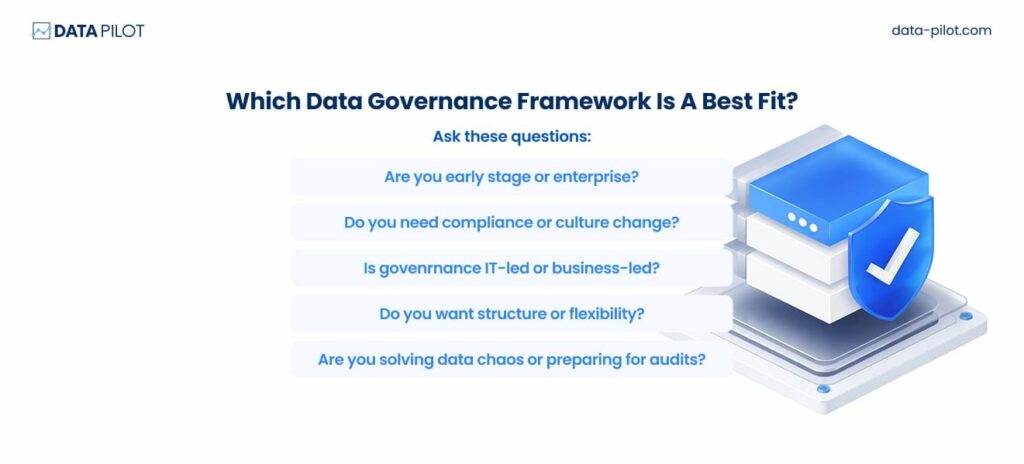 If you’re small or mid-sized: Start simple. DGI or parts of DAMA. If you’re enterprise: Blend DAMA with DCAM. If you’re compliance-heavy: COBIT + ISO standards. If you’re board-driven: ISO 38505 layered on top.
The Real Truth About Frameworks
Frameworks don’t fix data automatically. People fix data. You can adopt the most respected governance model in the world and still fail. Why? Because:
- No one owns the data.
- Leaders don’t enforce policies.
- Teams don’t trust the definitions.
- Governance feels like “extra work.”
Data governance only works when it supports business goals and reduces friction in your organization. It should also improve trust and help you make decisions faster. If governance slows you down, it’s being done wrong.
What Modern Data Governance Looks Like
Today’s governance is different from ten years ago. It’s about enablement. Modern governance focuses on:
- Clear definitions
- Shared data catalogs
- Transparent ownership
- Automation where possible
- Guardrails, not gatekeeping
The goal isn’t to control data, but to make trusted data easy to use and accessible. It’s about treating data as a strategic asset. With clear rules for ownership, quality control, and integrated oversight, it enables an organization to support AI readiness, analytics, and rapid decision making.
Common Mistakes Companies Make
 However, most companies aren’t perfect at data governance or choosing data governance frameworks. Here’s where most companies go wrong:
1. They buy tools before building policy.
If you buy data governance tools and you still haven’t devised a policy, your ship is going to sink pretty fast. It’s essential to have the foundation in place before you build the walls and provide bridges with tools.
2. They assign governance to IT only.
Data is everyone’s job, not only the technology department. Every department should have rules and procedures to save, use, and manage data.
3. They try to implement everything at once.
Start small and then build momentum. Data governance frameworks are vast and have alot of policies that can’t be implemented at once. Start with one area of focus and then spread.
4. They forget training.
Governance without education fails. If your team doesn’t know how to implement data governance and isn’t familiar with your company’s data governance policies, there will be chaos and you will fail in your governance efforts. Ensure you train everyone in your organization. If you’re overwhelmed, start here:
- Define 5 critical data elements (the different types of data that a business stores. For example, customer name, invoice no, items purchased, etc).
- Assign one owner per element.
- Document clear definitions.
- Set quality standards.
- Create a review process.
That’s it. You don’t need a 200-page document to begin, you can start small and build from here.
Final Thoughts
Data governance sounds technical, but it is simpler when understood and implemented gradually. It’s more about building trust and ensuring your data is accurate, updated, and easily accessible. When people trust data:
- Decisions speed up
- Conflicts drop
- Performance improves
- ROI increases.
Frameworks are tools. Choose the one that is the best fit, understand it, adapt it, and simplify it in relevant places. However, it is important to adapt to one of the mentioned frameworks to develop a proper system. Because without governance, data becomes noise. And in a world drowning in dashboards, clarity is your biggest advantage. Want to know if your data is ready for AI? Start our free assessment here.