
Poor data quality costs organizations an average of $12.9 million annually in wasted effort, incorrect decisions, and compliance failures. (Source: Gartner, “How to Stop Data Quality Undermining Your Business,” 2023, gartner.com)
The market has responded with a wide range of tools. These range from open-source validation frameworks that engineers write in Python, to enterprise observability platforms that automatically scan every table in your warehouse, to full-suite governance platforms that combine quality monitoring with lineage and cataloging.
The problem is not a shortage of tools. It is knowing which category of tool addresses the problem you actually have and which ones will sit unused six months after deployment.
This guide covers every major category of data quality and data standardization tool in 2026, compares the leading platforms in each, and gives you a practical framework for choosing the right fit for your team’s maturity and stack.
What Are Data Quality Tools?
Data quality tools are software that automatically detect, measure, and in some cases remediate errors in data. These errors include missing values, duplicates, format inconsistencies, schema violations, statistical anomalies, and stale records.
The best modern tools go beyond detection. They monitor pipelines continuously, alert teams before bad data reaches dashboards or models, and surface lineage so root causes can be traced.
They also integrate quality scores into the broader governance layer, so that “trustworthy” is a property data assets carry with them wherever they are consumed.
According to Forrester, data quality is the single biggest limiting factor for generative AI adoption across enterprises. (Source: Forrester Research, “The State Of Data Quality, 2024,” forrester.com)
AI models trained on inaccurate, inconsistent, or poorly labeled data produce outputs that cannot be trusted, and that problem compounds at the speed of model inference.
The Six Dimensions of Data Quality
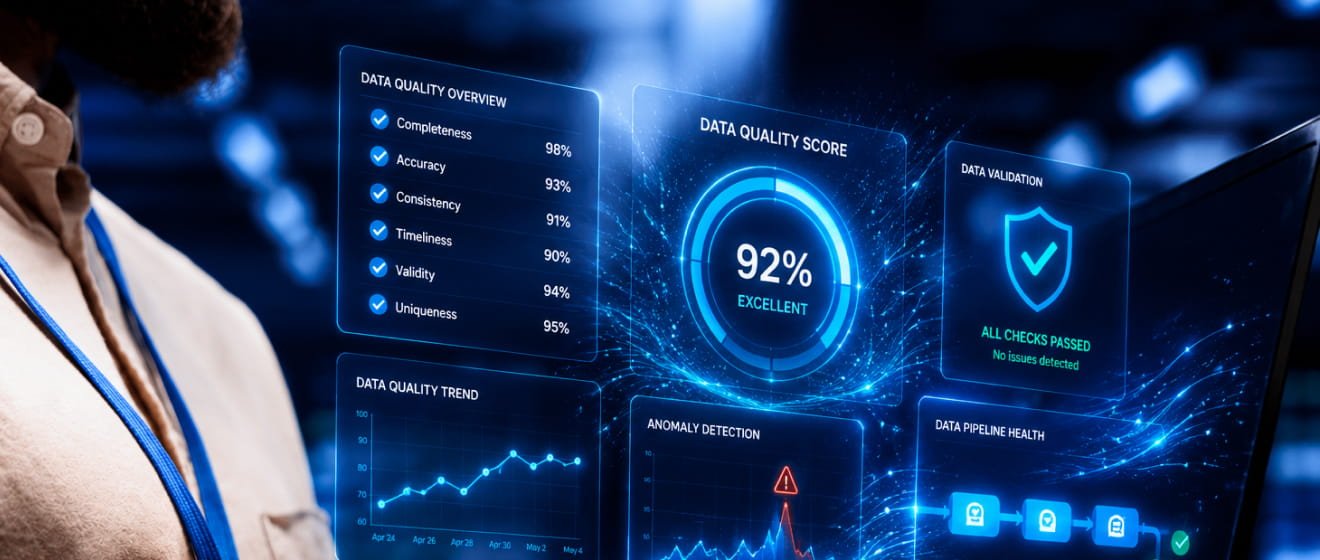
Before evaluating tools, align on what you are measuring. Data quality is assessed across six standard dimensions. Your tool should measure and report against all of them.
Dimension | What It Measures | Example Failure |
Completeness | No critical fields are missing or null | “Email” field is blank for 18% of customer records |
Accuracy | Values reflect real-world facts correctly | Transaction amount recorded as $1,200 instead of $12.00 |
Consistency | Same data agrees across systems | “Active customer” defined differently in CRM and billing system |
Timeliness | Data is current and updated within expected windows | Yesterday’s sales figures still showing 2-day-old numbers at 9am |
Validity | Values conform to defined formats and constraints | Date field contains “13/45/2026”, an impossible date |
Uniqueness | No unintended duplicate records exist | 34,000 duplicate customer records across merged databases |
The Three Categories of Data Quality Tools
Data quality tools in 2026 fall into three distinct categories. They are not alternatives to each other. Each addresses different parts of the quality problem, and they are most effective when deployed in combination.
1. Enterprise governance and quality platforms
These platforms combine data quality with cataloging, lineage, governance, and in some cases MDM (master data management). They are designed for organizations where data quality is a compliance obligation as much as an operational concern.
Examples: Informatica IDMC, Collibra, Ataccama, Atlan, Talend (Qlik). They are expensive, take months to deploy, and require dedicated data governance teams to operate effectively.
Choose this category when you have regulatory compliance requirements (GDPR, HIPAA, BCBS 239). It also fits when you need a unified governance and quality layer across multiple domains, or your data quality program is mature enough to warrant enterprise tooling.
2. Cloud-native observability tools
These tools monitor data pipelines automatically, using machine learning to detect anomalies in freshness, volume, distribution, and schema without requiring you to manually define every quality rule.
Examples: Monte Carlo, Anomalo, Bigeye, Metaplane, Acceldata. They are faster to deploy than enterprise platforms (days to weeks rather than months), and they are built for modern cloud stacks like Snowflake, Databricks, and BigQuery.
Choose this category when your primary problem is detecting unexpected data failures before they reach dashboards and business users. It also fits when you do not have the governance maturity for a full enterprise platform, or your team is data engineering-centric.
3. Open-source validation frameworks
These frameworks give data engineers programmatic control over data quality checks written as code, version-controlled, and embedded directly in pipelines.
Examples: Great Expectations, Soda Core, dbt tests, Apache Griffin, AWS Deequ. They have no license cost, require Python or SQL skills to implement, and provide maximum flexibility for teams that want custom validation logic.
Choose this category when your team is engineering-led. It also fits when you want quality checks embedded in CI/CD pipelines, or you need a free starting point before investing in commercial tooling.
Data Quality Tools Compared: The Leading Options in 2026
Tool | Category | Primary Strength | Best Stack Fit | Pricing |
Informatica IDMC | Enterprise platform | Deep AI-driven profiling, cleansing, MDM across hybrid environments | Complex multi-cloud + on-prem, regulated industries | $100K+ / yr |
Collibra | Enterprise platform | Governance-first quality with full lineage and stewardship workflows | Large enterprise; compliance-heavy environments | $100K+ / yr |
Ataccama | Enterprise platform | End-to-end: profile, cleanse, master, and publish governed data | Organizations needing MDM + quality in one platform | Custom pricing |
Atlan | Enterprise platform | Active metadata + quality signals unified with governance and discovery | Modern stacks (Snowflake, Databricks, dbt) | $40K–$120K+ / yr |
Qlik Talend | Enterprise platform | Unified integration + quality with embedded Talend Trust Score | Teams already using Talend for ETL | Custom (incl. Open Studio free) |
Monte Carlo | Observability | End-to-end pipeline reliability: freshness, volume, schema, lineage | Large modern data stacks with complex pipelines | Custom enterprise pricing |
Anomalo | Observability | ML-based anomaly detection without manual rule configuration | Snowflake, Databricks, BigQuery; no-code monitoring | Custom pricing |
Bigeye | Observability | Rule-based + ML quality tightly integrated with major warehouses | Snowflake, BigQuery; mid-market data teams | Tiered; starts low thousands/mo |
Metaplane | Observability | Transparent, affordable observability; strong for mid-size teams | Snowflake, dbt, Fivetran stacks; cost-conscious teams | Tiered; transparent pricing |
Great Expectations | Open source | Expressive Python-based validation tests embedded in CI/CD pipelines | Engineering-led teams; Python-native workflows | Free (GX Core); paid cloud tier |
Soda Core | Open source | SQL-native quality checks with broad connector support, fast setup | Teams wanting lightweight checks without Python overhead | Free (OSS); paid cloud |
dbt tests | Open source (embedded) | Quality checks embedded directly in the SQL transformation layer | Any team already running transformations in dbt | Free within dbt core |
Data Standardization Tools: The Specific Use Case
Data standardization is a subset of data quality. It addresses the problem of inconsistent formats, naming conventions, and representations, where the same entity is expressed differently across systems.
Common standardization problems include customer names stored as “John Smith,” “Smith, John,” and “J. Smith” across three systems.
Other examples: dates formatted as MM/DD/YYYY in one system and YYYY-MM-DD in another, country codes as “US,” “USA,” and “United States,” and phone numbers with and without country codes.
These inconsistencies are invisible in individual records but catastrophic when you try to join, deduplicate, or aggregate across sources.
Tools with strong standardization capabilities
Informatica IDMC is the benchmark for enterprise-scale standardization. Its CLAIRE AI engine automatically detects patterns in address, name, and product data and applies standardization rules without manual configuration. It handles global data formats natively.
Precisely Trillium Quality specialises in customer and contact data standardization, particularly for financial services and regulated industries. It handles global address formats, name parsing, and entity resolution at enterprise scale.
Talend (Qlik) embeds standardization rules directly in ETL jobs, applying transformations during data ingestion rather than after the fact. It is particularly useful for organizations that want to standardize data at the point of entry into the warehouse.
For engineering-led teams, dbt macros combined with Great Expectations provide a code-first standardization approach. Transformations that normalize formats are written in SQL, version-controlled, and validated automatically.
The relationship between standardization and MDM
Standardization is the first step in master data management (MDM).
You cannot build a golden record, the authoritative single view of a customer, product, or supplier, without first standardizing the representations of that entity across all source systems.
Teams that conflate standardization with MDM often underestimate the effort involved. Standardization eliminates format inconsistencies.
MDM additionally resolves entity identity, determining that “IBM Corp,” “International Business Machines,” and “IBM” all refer to the same organization. It also manages the survivorship logic that selects which attribute values to use in the golden record.
How to Choose the Right Data Quality Tool
The most common mistake is selecting a tool based on features rather than on the organization’s actual quality problem.
A team that is primarily suffering from unexpected pipeline failures needs an observability tool, not an enterprise governance platform. A compliance team that needs audit-ready evidence of data quality controls needs an enterprise platform with governance workflows, not a Python testing framework.
These six questions determine which category and which specific tool is the right starting point.
- What is your most urgent quality problem? Each problem, from pipeline failures to compliance audits, maps to a different tool category.
- Who will operate the tool? Engineering-led teams can use open-source or observability tools; programs involving business stewards need non-technical interfaces.
- What is your current stack? Verify the tool works with your specific warehouse, dbt version, and BI platform, not just that it “supports” them generically.
- Do you need to fix data or monitor it? Many organizations need both an observability layer for detection and an enterprise platform for remediation.
- What is your governance maturity? Buy the tool that matches where you are now, not where you plan to be.
- What is the realistic total cost of ownership? Implementation, internal engineering, training, and maintenance typically add 40–60% to the first-year cost. (Source: Gartner, “How to Evaluate Total Cost of Ownership for Data Quality Tools,” gartner.com, 2024)
What a Mature Data Quality Program Looks Like
Most organizations start with reactive quality management fixing problems after they are reported. The goal is to move upstream.
A mature data quality program has three layers working together.
Validation at the source: quality rules embedded in ingestion pipelines that catch format violations, null violations, and referential integrity failures before data enters the warehouse.
Monitoring in the warehouse: automated checks that continuously monitor freshness, volume, distribution, and schema across critical data assets.
Governance integration: quality scores surfaced in the data catalog alongside ownership information, so data consumers can see the quality history of a dataset before using it in a report or model.
Each layer corresponds to a tool category. Pipeline validation maps to open-source frameworks (dbt, Great Expectations). Warehouse monitoring maps to observability platforms (Monte Carlo, Bigeye). Governance integration maps to enterprise platforms (Informatica, Collibra, Atlan).
The teams that extract the most value from data quality investment are not the ones with the most sophisticated tools.
They are the ones that have defined what “good enough” means for each data domain, assigned ownership for maintaining it, and built the measurement infrastructure to know when they are below that standard.
Final Thoughts: Start With the Problem, Not the Platform
The data quality tool market is well-served in 2026.
There are reliable open-source frameworks for teams that want code-level control. There are cloud-native observability platforms that detect anomalies without manual rule configuration. There are enterprise platforms that combine quality with governance at the level that regulated industries require.
The failure mode is not picking the wrong tool. It is picking a tool before the quality problem is clearly defined, and deploying it into an environment without the ownership structures and processes needed to act on what it finds.
A data quality tool that surfaces hundreds of alerts without clear owners responsible for resolving them does not improve data quality. It adds noise. The process design and organizational accountability come first.
If you are assessing your current data quality posture, building the case for a quality program, or choosing between tools for your specific stack, Data Pilot can help.
Our data strategy consulting helps teams get the sequencing and tool selection right before the procurement decision is made.