

Rapid AI experimentation has shifted from small-scale tests to full-scale enterprise transformation. Today, organizations are integrating AI into their core operations, decision-making, and product strategies. But, is your organization AI ready?
Many are finding the journey more demanding than anticipated. According to Gartner, 57% of organizations estimate their data is not AI-ready and AI projects built on unprepared foundations are prone to failure.
Businesses risk costly mistakes when they rush into AI without a mature data foundation. A Gartner survey found that 63% of organizations either do not have or are unsure they have the right data-management practices for AI.
For decision-makers CTOs, CIOs, Heads of Analytics, CMOs in both mid-sized and large enterprises, the question isn’t simply “Can we do AI?” but “Are we ready to do AI and to get value from it?”
Understanding Data Maturity: The Foundation of AI Readiness
What is Data Maturity?
Data maturity describes how well an organization has established its data capabilities – people, processes, platforms – that enable data to become a strategic asset. In AI, maturity means having clean, reliable data that is well-managed and supports the company’s goals.
More specifically, it is the measure of how effectively an organization collects, manages, analyzes, and uses data to drive decisions, optimize operations, and create value. It reflects the organization’s evolution from basic data awareness to fully integrated, strategic, and predictive use of data across all functions.
A data-mature organization has:
- Trusted, high-quality data available when and where it’s needed
- Standardized processes for governance, privacy, and access
- Advanced analytical capabilities, from dashboards to AI models
- A culture that consistently uses data insights to guide decisions at every level
- Technology and infrastructure built to support fast, scalable, real-time insight generation
Data maturity isn’t just about having data. It’s about having the systems, skills, culture, and leadership needed to turn that data into reliable, repeatable, and high-impact action.
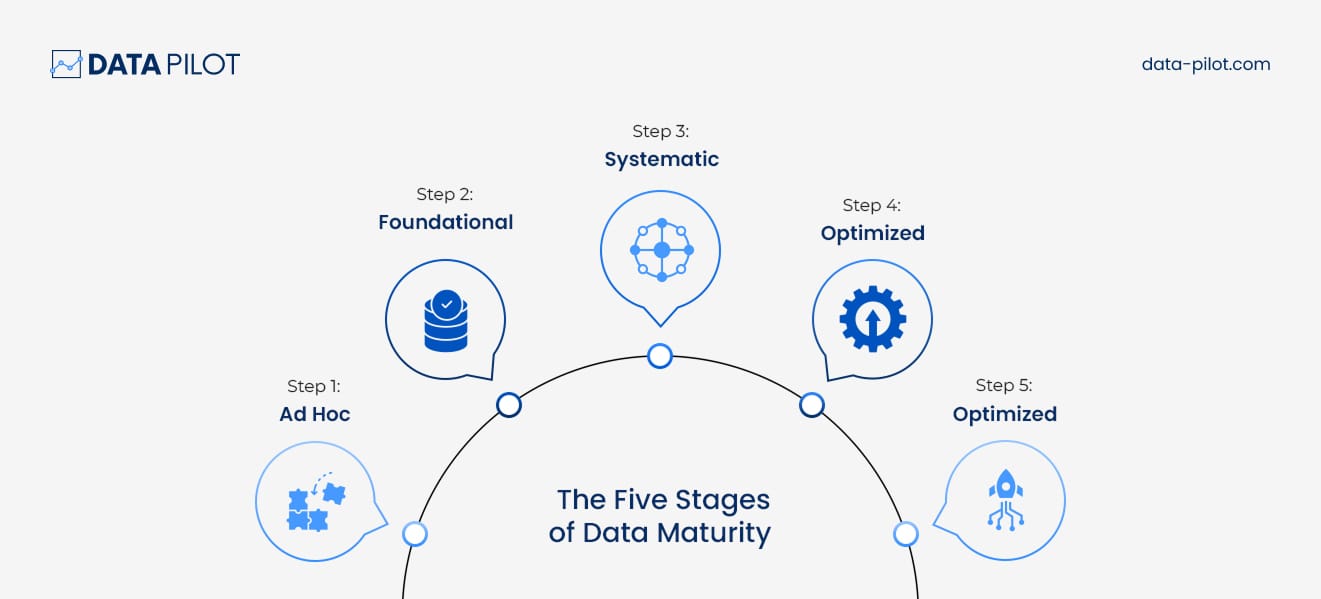
The Five Stages of Data Maturity
There are five progressive stages to data maturity:
- Ad Hoc: Data practices are informal, siloed, and reactive.
- Foundational: You have basic data infrastructure, governance, and more awareness.
- Systematic: Data is integrated across units, governed, and somewhat standardized.
- Optimized: Data practices are efficient, proactive, analytical, and AI-enabling.
- Transformational: Data and analytics underpin the business model; AI and data-driven innovation are core.
Let’s assess whether you are Data and AI-ready for 2026.
Also Read: Driving a Data-Driven Culture: How Leadership Can Help
The 2026 AI Readiness Checklist
Here is a practical checklist to assess whether your organization is primed for AI. We recommend using this as a visual share-and-download asset for teams.
| Check | Description |
| Centralized, Clean and Accessible data | Data from various sources is integrated, accessible to analytics/AI teams, with consistent formats and minimal silos. |
| Robust Data Governance and Compliance | Policies for data quality, metadata, lineage, privacy and ethics are in place, with accountability over data assets. |
| Integrated Systems and Data Pipelines | End-to-end pipelines move data from source → processing → AI/analytics consumption; minimal manual hand-off. |
| Cloud Infrastructure or modern Data Stack | Scalable, flexible environment (cloud or hybrid) and a modern data stack (data lake/warehouse, data-ops, orchestration) to support AI at scale. |
| AI Literacy Across Teams | Business, data-analytics and technology teams understand AI use-cases, limitations, trust issues; there is training and cross-functional collaboration. |
| Leadership Buy-in and Clear AI Vision | Executives understand AI’s potential and constraints, there is a clear roadmap, sponsors and defined KPIs aligned to business goals. |
| Budget and KPIs for AI Transformation | Funding is allocated (for pilots and scaling), KPIs have been defined (not just technical metrics but business impact: revenue, cost, risk reduction). |
If you have checked all the boxes in the checklist, then you are in pretty good shape to scale your business next year with real-time decision-making and AI-efficient processes. If you aren’t in line with some of these, it’s a good time to reassess and plan for next year!
Self Assessment Questions to Assess Your Organization’s AI Readiness
You can also go into depth when assessing your organization’s AI readiness by answering these data maturity questions.
- Are data sources mostly in spreadsheets and departmental apps? Is there no consistent data catalogue?
- Do you have a data warehouse or lake, but still many manual integrations? Is data governance rudimentary?
- Are business units and analytics teams working from consistent, shared data models? Do you track data lineage and quality metrics?
- Are analytics and AI initiatives aligned with business outcomes? Do you have reusable data products, observability, and active metadata?
- Is AI integrated into multiple processes? Is there a center of excellence? Is data & AI leveraged as a revenue stream or strategic differentiator?
If you answered yes to most of these questions, you are in a good place. However, if you answered a few with “no”, it’s not the end of the world, but you have to upgrade to remain competitive in the industry. Here’s how to make improvements in time for next year.
Is your business
AI-prepared?
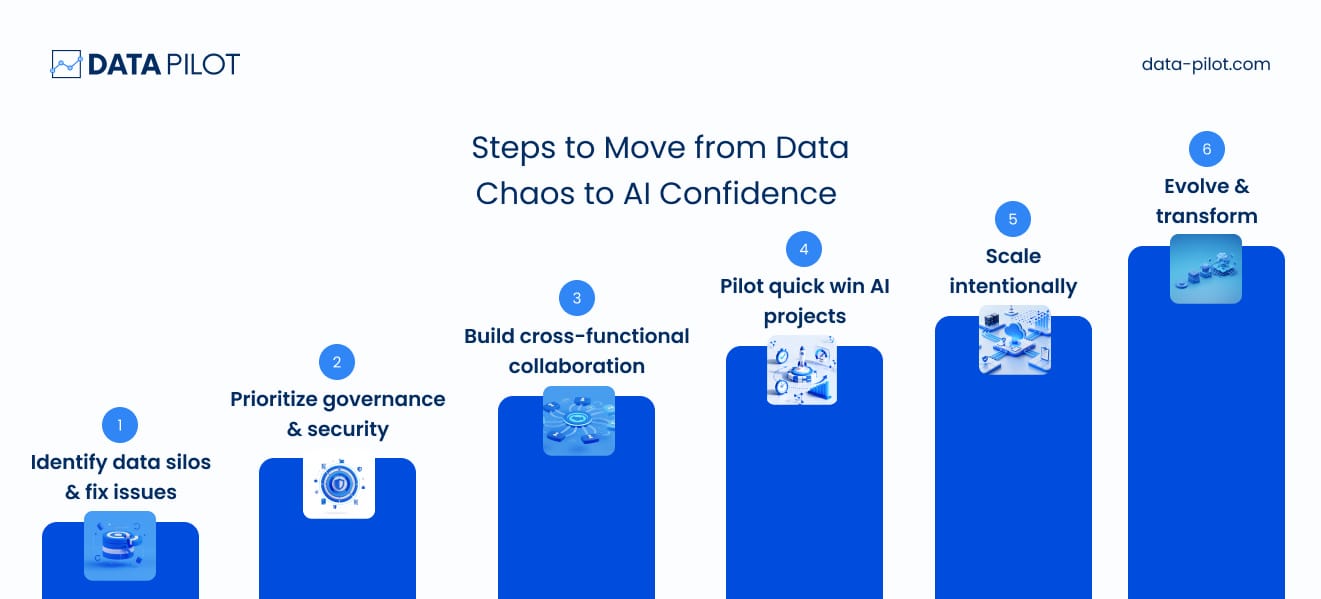
Steps to Move from Data Chaos to AI Confidence
1. Identify data silos and fix integration issues
Map out where data lives (departments, systems, external). Begin to integrate.
2. Prioritize governance and security
Establish data ownership, cataloging, lineage, quality metrics , and privacy compliance.
3. Build cross-functional collaboration
Bring business, analytics, and IT teams together. Foster AI literacy and shared language.
4. Start small: Pilot AI projects that demonstrate quick wins
Choose a well-scoped use case with business alignment, defined KPI, accessible data, and incremental value. Use it to build momentum.
5. Scale intentionally
Once the pilot proves value, focus on the platforms, pipelines, and governance needed for scale.
6. Evolve towards transformational maturity
Continuously improve data assets, treat data as a product, and embed AI into daily operations and business workflows where it adds the most value.
Common Red Flags That You’re Not AI-Ready
Last but not the least, if you aren’t able to answer the questions above, you may be able to spot red flags that signal your data and systems aren’t ready to implement AI and generate revenue from it. Here are a few signs that your organization is not AI-ready:
a) Poor data quality (missing values, inconsistent formats, unclear lineage)
b) Fragmented systems and multiple legacy platforms with limited integration
c) Lack of leadership alignment or unclear business case for AI
d) No defined data ownership or governance structure
e) Business users distrust analytics or AI outputs
f) Budget for proof-of-concepts but no plan to scale
If you recognize any of these red flags in your organization, it may be time to pause the rush into AI tools and first shore up the foundations. Once your data infrastructure is mature and ready, you’ll be able to experience exponential returns from AI – when implemented in the right workflows.
The Business Impact of Being AI-Ready
Simply put, being AI-ready drives business impact. Companies with high AI maturity report:
1- Faster decision-making and operational efficiency: With data and AI embedded, decisions rely less on gut feeling and more on insight.
2- Stronger predictive capabilities: Moving from reactive to proactive business models (e.g., predicting churn, optimizing supply chain, dynamic pricing).
3- Competitive edge through data monetization: Data and AI become strategic assets, enabling new business models or services.
Ready to Assess Your AI Readiness?
If you’re ready to take the next step, we invite you to take Data Pilot’s Data and AI Readiness Assessment.