

In 2026, data governance goes well beyond basic catalogs and lineage tracking. Today’s data governance tools use AI to automate discovery, support compliance, build trust in data, and surface insights sooner, so you can help your teams make smarter decisions in less time.
Instead of relying on manual rules and heavy setup, AI-driven open-source governance tools pair machine learning with community input to give you governance that scales, stays transparent, and fits enterprise needs.
According to a recent industry forecast, the global data governance market is expected to grow from USD 5.38 billion in 2025 to USD 24.07 billion by 2034, exhibiting a compound annual growth rate (CAGR) of around 20.5%
Below, you’ll get a close look at the top five open-source data governance tools in 2026, what sets them apart in the age of AI, how they fit into modern data stacks, and what you should weigh before you adopt one.
What are AI-powered data governance tools?
AI-powered data governance tools are software platforms that use artificial intelligence to help organizations manage, protect, and make sense of their data more efficiently. They automatically classify data, detect sensitive information, enforce compliance rules, and monitor data quality across systems in real time.
Unlike traditional governance tools that rely heavily on manual setup and rule-based controls, AI-driven solutions can learn patterns in data usage, flag anomalies, and adapt policies dynamically. This makes it easier for businesses to maintain regulatory compliance (such as GDPR or HIPAA), reduce risk, and improve data accessibility for teams.
In short, AI-powered data governance tools help organizations ensure their data is accurate, secure, compliant, and usable—at scale and with less manual effort.

OpenMetadata: The Modern Governance Hub
Overview
When you look at AI-driven governance, OpenMetadata stands out. It’s a community-led, open-source metadata platform, and many teams now treat it as the go-to choice for discovery, lineage, quality, and governance across distributed systems. It works well because it brings your metadata together in one place, using modern APIs and smart automation.
Since its 2021 launch, OpenMetadata has gained traction fast. That growth comes from a flexible design and clear value in cloud, hybrid, and on-prem environments. For many leaders comparing data governance tools, it has become a practical and trusted option.
What Makes It AI-Powered?
OpenMetadata uses machine learning and automation in ways that save your team time and improve accuracy.
With automated metadata discovery and classification, you don’t have to map everything by hand. Instead, the platform scans large numbers of data sources, pulls in metadata, labels asset types, and identifies schema patterns on its own.
It also improves search with semantic search and suggestion features. So when you use natural language to look for data, you get results based on meaning and context, not just exact keywords.
For lineage, OpenMetadata can help build graph-based views by examining data movement, links between systems, and transformation paths. As a result, you get a clearer picture of where data comes from and how it changes.
At the same time, it supports quality and compliance monitoring. As data comes in, machine-assisted profiling and scoring can flag quality gaps and possible compliance issues in near real time.
Strengths
One clear advantage is connectivity. OpenMetadata supports more than 80 connectors across databases, data lakes, BI platforms, ELT tools, and messaging systems.
It also gives you a unified metadata model. Because governance, discovery, and observability live in one repository, your teams can avoid the silos that slow decisions down.
In addition, its APIs and SDKs make custom integration easier. So you can build governance into the workflows your teams already use, instead of forcing a separate process.
Adoption Tips
Start with discovery first. If you use OpenMetadata for automated classification and lineage early on, you can raise trust in your data quickly.
Next, connect it with quality tools. Pairing it with open-source options like Soda or Great Expectations gives you deeper checks and stronger validation workflows.
Also, encourage your teams to use AI-powered search. When you show people how to search with natural language, adoption tends to rise, especially among non-technical users.

Egeria: Federated Metadata Exchange for Multi-Tool Governance
Overview
Egeria is an open-source governance project within the Linux Foundation’s AI & Data group. If you work across a mix of SaaS apps, cloud platforms, and older systems, it gives you a practical way to connect metadata from many places.
As your environment gets more complex, you need data governance tools that can link metadata stores, standardize formats, and give you one clear view of governance across sources. That’s where Egeria stands out. It helps you coordinate metadata across different systems, even when those systems don’t speak the same language.
What Makes It AI-Powered?
Egeria didn’t start as an AI-first platform, but its 2026 updates add several AI-driven features.
For metadata normalization, machine learning helps match terms and data definitions across business domains. As a result, you get more consistent metadata, even when teams use different labels and standards.
It also supports contextual mapping and pattern recognition. Instead of relying only on fixed mappings, Egeria can spot repeat patterns and suggest governance links on its own.
In addition, the platform can automate policy assignment. By reviewing content meaning and context, it can recommend governance zones and likely regulatory handling.
Strengths
Egeria works well as a vendor-neutral option, so you can connect tools across different vendors and formats. It also supports federated metadata exchange, which helps you bring together canonical metadata from systems that would otherwise stay disconnected. Just as important, it offers strong lineage and provenance, so you can track where metadata came from and how it changed over time.
Best Use Cases
If you lead a large hybrid organization, Egeria can be a strong fit. It works well when you have many data domains, several cloud services, and legacy platforms that still matter to the business.
It also makes sense for decentralized teams. When your groups work with a lot of independence, Egeria helps keep metadata and governance practices aligned without creating a central bottleneck.

DataHub: A Unified Discovery & Governance Platform
Overview
If you’re looking at DataHub, you should know it started inside LinkedIn as an internal metadata system. Later, it became an open-source platform for the broader data community. It brings data discovery, cataloging, lineage, and governance together in one scalable platform. Because it’s built to be flexible, you can shape it around your needs as your data environment grows and changes.
What makes it AI-powered?
DataHub includes AI-based features that help you automate work and cut down on manual governance tasks.
Smart metadata ingestion helps you bring in new data sources faster. As data comes in, AI-assisted processes can spot schema structures, detect relationships, and recognize metadata patterns.
Automated data classification helps you organize assets with less manual effort. Machine learning models sort data by type, usage, sensitivity, and business context.
AI-augmented lineage gives you a clearer view of how data moves. It can infer hidden or missing links across pipelines and workflows, so you get better traceability and visibility.
Strengths
A connected metadata graph gives you a full view of your data estate. You can see assets, owners, metrics, schemas, and lineage in one place, which makes it easier to understand how everything connects.
Its modular design gives you room to start small and expand over time. You can roll out core catalog features first, then add governance, compliance, or observability as needed.
DataHub also supports a wide set of connectors. So, you can connect databases, cloud data warehouses, BI tools, and streaming platforms without forcing everything into one stack.

Best use cases
DataHub fits large organizations that manage complex, distributed data environments.
It’s also a strong choice if you need one place for data discovery and lineage across many tools.
If you’re rolling out data governance tools and compliance programs at scale, it gives you the structure to support that work.
It also works well for engineering and analytics teams building metadata-driven data platforms.
And if you want open-source data governance tools that you can customize, DataHub stands out as a practical option.

Apache Atlas: Proven Governance with Enterprise Lineage
Overview
If you need one of the more established data governance tools, Apache Atlas is a strong option. It started in the Hadoop ecosystem, but it now fits into more modern data environments too. You get key features for metadata management, data classification, and lineage tracking. Because of that, many enterprises trust it for governance in regulated settings. Over the years, Atlas has stayed useful thanks to its clear lineage views and dependable classification framework.
What makes it AI-powered?
Apache Atlas wasn’t built as an AI-first platform, but newer versions add AI and machine learning to reduce manual work and improve governance.
- AI-assisted ingestion helps you collect and organize metadata from many data sources with less setup.
- Machine learning models improve classification over time by learning from user actions and governance patterns.
- Pattern recognition can suggest lineage updates as your data changes, so your lineage stays more accurate and easier to maintain.
Strengths
- You benefit from a mature open-source community and broad enterprise adoption, which gives Atlas a solid track record in large production environments.
- You get strong lineage visualization, so you can see upstream and downstream relationships clearly for compliance and impact analysis.
- It works well with Apache Ranger, which helps you pair governance with strong access control and security policies.
Best use cases
Apache Atlas makes sense if you run a large Hadoop-based or hybrid data environment. It’s also a good fit when you need strict compliance, audit support, and dependable lineage tracking. If your team already uses Apache tools like Hadoop, Spark, and Ranger, Atlas can fit in naturally. It’s also a smart choice when you want data governance tools with proven stability and growing AI support.

Collate (Powered by OpenMetadata): AI-Augmented Governance Simplified
Overview
If you want strong governance without the hassle of running it yourself, Collate gives you that option. It’s a managed platform built on the open-source OpenMetadata project, so you get the benefits of a proven foundation without taking on the full burden of setup and scale. As a result, you can put enterprise-level governance in place through a simpler, more user-friendly experience.
That makes it easier for your team to adopt advanced metadata management, data cataloging, and governance features. It’s especially helpful if you don’t have deep infrastructure skills in-house. Among modern data governance tools, Collate stands out for making complex work feel much more manageable.
What makes it AI-powered?
Collate uses AI throughout the governance process, so you spend less time on manual tasks and more time getting value from your data.
Its conversational AI interface lets you search and explore data assets with natural language. Because of that, you don’t need to know technical schemas to find what you need.
It also supports automated sensitivity tagging. Machine learning models can spot and label sensitive or regulated data across datasets, which helps you move faster while keeping control.
In addition, Collate looks at how people use data across your company. It then suggests governance policies, ownership models, and ways to improve performance based on real usage patterns, not just fixed rules.
Strengths
Collate is easy to adopt, which is a big plus if you want results quickly. Since it’s managed, you avoid much of the setup work that comes with self-hosted open-source data governance tools.
You also get built-in intelligence that cuts down on manual work. AI helps with classification, discovery, and policy setup, so your team can focus on higher-value work.
Another strength is context. Rather than relying only on static governance rules, Collate gives you recommendations based on how your organization actually uses data.
Best use cases
Collate works well if your organization moves quickly and needs governance in place without a large engineering lift.
It’s also a strong fit if your team doesn’t have much experience deploying or maintaining open-source governance platforms.
If you’re focused on faster data discovery and stronger self-service analytics, this platform can help you get there sooner.
It’s also a smart option if you want AI-driven governance but don’t want to build custom tools from scratch.
Comparison of the Top 5
Here’s how the tools stack up across key dimensions in 2026:
| Tool | AI Automation | Lineage & Classification | Deployment Complexity | Community Strength | Best For |
| OpenMetadata | ⭐⭐⭐⭐ | ⭐⭐⭐⭐ | Medium | High | Best for you if you want flexible, open-source data governance tools with solid AI support for modern data teams |
| Egeria | ⭐⭐⭐ | ⭐⭐⭐⭐ | High | Medium | Best for you if your enterprise needs deep governance models and strong metadata standards |
| DataHub | ⭐⭐⭐⭐ | ⭐⭐⭐⭐ | Medium | High | Best for you if you need a scalable metadata platform with strong extension options and an active developer community |
| Apache Atlas | ⭐⭐ | ⭐⭐⭐⭐ | High | High | Best for you if you work in Hadoop-based or compliance-focused settings that need trusted lineage and tight control |
| Collate (OpenMetadata) | ⭐⭐⭐⭐ | ⭐⭐⭐⭐ | Low | Medium | Best for you if you want managed governance, quick setup, and helpful AI support with less overhead |
Why AI Matters in Data Governance
Governance used to rely on spreadsheets, fixed rules, and manual audits. Now, AI gives you a better way to manage it. With modern data governance tools, you can move faster, see more clearly, and act before small issues turn into bigger risks.
Automate Discovery and Classification
AI can find datasets, map schema structures, and spot relationships without hours of manual work. As a result, you get a real metadata base instead of scattered spreadsheets and partial records.
Contextual Search and Insights
Natural language search helps you find the right data by using plain English. So, your business teams can locate assets without SQL, dashboards, or long filter chains.
Predictive Compliance
AI can catch patterns that point to compliance risk before an audit happens. Because of that, you can address problems early instead of reacting after the fact.
Intelligent Policy Enforcement
Static rules can fall behind quickly. AI models can adjust policies based on how people use data and how regulations change over time.
Challenges to Keep in Mind
- Open-source data governance tools can save money, but they often need strong technical support. If you want to scale AI features, you’ll likely need infrastructure, DevOps, and platform engineering help.
- AI works best when your data is clean and reliable. If data quality is weak, trust drops fast. That’s why quality tools, such as Great Expectations, matter so much.
- Community support can be very helpful, and many teams do well with it. Still, if you need enterprise SLAs, managed services or paid support may be the better fit.
- Compliance rules keep shifting, including GDPR, CCPA, and new AI-focused standards. Because of that, your governance approach needs regular updates, not a one-time setup.
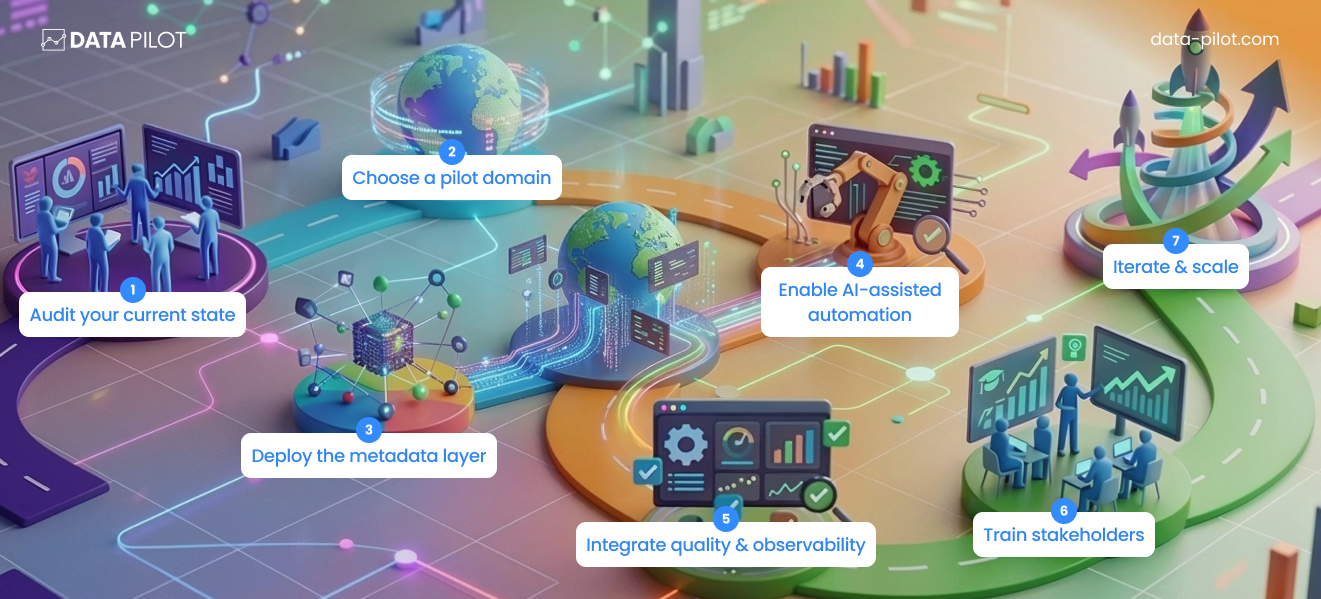
Implementation Roadmap: How to Adopt These Tools
- Audit Your Current State:
Evaluate existing catalogs, lineage maps, and policy repositories. - Choose a Pilot Domain:
Start small. Apply governance to a key data domain first (e.g., customer data). - Deploy the Metadata Layer:
Tools like OpenMetadata or DataHub provide the foundation. - Enable AI-Assisted Automation:
Configure AI scoring, classification, and lineage engines. - Integrate Quality & Observability:
Pair with open-source quality tools for full data health governance. - Train Stakeholders:
Educate analysts, stewards, and business users on governance best practices. - Iterate & Scale:
Expand governance coverage as confidence and adoption grow.
Conclusion
By 2026, using AI to manage your company data is no longer just a trend; it is a basic requirement for success. These open-source data governance tools help you automate big tasks and see patterns before they happen. Best of all, you can use these smart features without paying for expensive private software.
You might lead a small startup or a massive corporation. Either way, you need modern options like OpenMetadata, Egeria, DataHub, Apache Atlas, and Collate to stay ahead. Each one offers different perks, so you can pick the one that fits your team best.
Moving away from old, manual work helps your staff trust the numbers they see every day. This shift helps you follow rules faster and gives your team the power to make bold choices. In 2026, keeping your data clean and organized is how you win against your rivals.
Open-source platforms make it easier to scale your growth without blowing your budget. Because these tools learn as they go, your data stays accurate as your company changes. Most importantly, this setup lets your experts focus on big ideas instead of fixing spreadsheets all day. Your business stays fast and flexible while your competitors struggle with messy files.
Ready to build a scalable data governance framework or modernize your data infrastructure? Book your free consultation now.