
Most data governance programs fail for a simple reason. They lack sequence.
Organizations try to govern everything at once. They assign ownership without authority. They invest in tooling before the foundational policies exist. The result is a well-documented initiative that changes nothing.
A data governance roadmap template solves this.
It is the difference between a governance strategy, which defines what you want to achieve, and a governance program, which defines what you do, in what order, and how you measure progress.
This guide walks through every phase of building one. It also includes a template you can adapt to your organization.
What Is a Data Governance Roadmap? The Direct Answer
A data governance roadmap is a phased, time-bound plan. It sequences the actions, roles, policies, and technology investments an organization needs.
The goal is to move from a current data management state to a defined future state of mature, sustainable governance.
It is distinct from a governance framework. A framework defines the structural elements of governance, such as policies and ownership models.
However, a framework does not tell you the order to implement them or how to build momentum. The roadmap answers those questions.
It turns a governance framework into an executable program with milestones, owners, and measurable outcomes.
Gartner estimates that through 2026, 80% of finance organizations will miss their ROI on advanced analytics because their data governance is not modernized. (Source: Gartner, “Finance Data and Analytics Governance: 2024 Survey,” gartner.com) The roadmap is the mechanism that drives modernization. Without it, governance remains aspirational.
Roadmap vs Framework vs Strategy: Getting the Definitions Right
These three terms are used interchangeably and inconsistently across the industry. The distinctions matter because confusing them leads to organizations that have thorough frameworks but no execution plan and vice versa.
| Term | What It Is | What It Answers |
| Data Governance Strategy | The goals and principles guiding how data is managed as a business asset | “Why are we doing this and what does success look like?” |
| Data Governance Framework | The structural components roles, policies, standards, processes that govern data | “What are the building blocks of our governance program?” |
| Data Governance Roadmap | The sequenced implementation plan with phases, timelines, and milestones | “What do we do first, second, and third and by when?” |
All three are necessary. The strategy sets direction. The framework defines structure. The roadmap drives execution. Organizations that have the first two but not the third consistently stall.
Why Sequence Matters More Than Completeness
The single most common governance failure mode is attempting to do everything simultaneously.
Organizations produce comprehensive policy documentation, stand up a governance council, procure a data catalog, and launch data quality initiatives across multiple business domains, all in the same quarter.
Adoption stalls because no single initiative is complete enough to demonstrate value before the next one demands attention.
Pilot-first approaches succeed four times more often than enterprise-wide rollouts, according to Forrester Research. (Source: Forrester Research, “The Data Governance Playbook,” forrester.com, 2024)
The rationale is straightforward. A governance program that delivers a visible, measurable win within the first 90 days builds executive confidence and cross-functional buy-in.
That early win is what allows the program to scale. A program that asks the organization to trust the process for 18 months before any benefit is visible will not survive the first budget cycle.
A well-sequenced roadmap identifies the highest-impact, lowest-complexity domain for the initial phase. It delivers a concrete outcome there, then uses that outcome as the proof point for expanding governance across the organization.
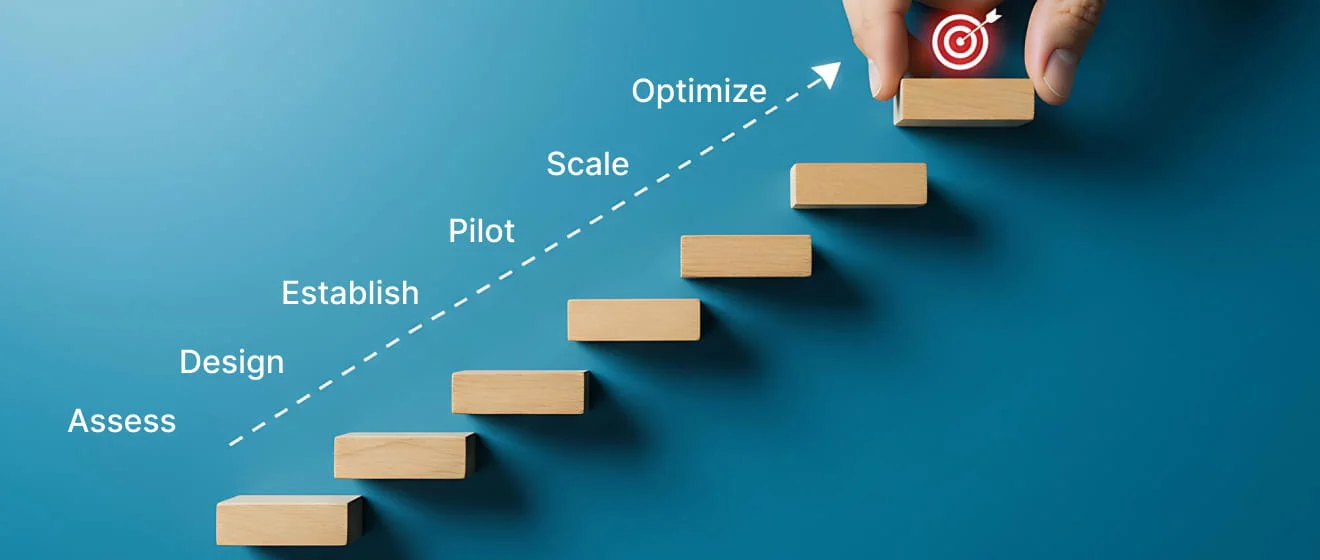
The Data Governance Roadmap: A Six-Phase Model
The template below reflects a phased approach validated across enterprise data governance programs. Timeline ranges are indicative they compress for organizations with dedicated resources and expand for those managing governance alongside other transformation priorities.
| Phase | Timeline | Core Activities | Key Deliverable |
| 1. Assess | Weeks 1–4 | Data maturity assessment; inventory of existing policies, roles, and tools; stakeholder interviews; identification of critical data domains and known quality issues | Current state report and prioritized gap analysis |
| 2. Design | Weeks 4–8 | Define governance vision and objectives; design ownership and stewardship model; draft core policies; select pilot domain; define success metrics | Governance charter, ownership model, and pilot scope |
| 3. Establish | Months 2–4 | Stand up Data Governance Office or council; assign data owners and stewards; implement business glossary for pilot domain; configure data catalog for pilot scope | Operational DGO; catalogued pilot domain with defined critical data elements |
| 4. Pilot | Months 3–6 | Apply governance policies in pilot domain; implement data quality monitoring; track lineage for critical data assets; measure against defined success metrics | Pilot results report; quantified business impact; lessons learned |
| 5. Scale | Months 6–18 | Expand governance coverage to additional domains; roll out training and data literacy program; integrate governance into data pipelines and workflows; extend catalog coverage | Enterprise-wide governance coverage; embedded stewardship model |
| 6. Optimise | Months 12+ | Implement automated quality monitoring; add AI governance policies; continuously refine based on metrics; conduct annual maturity reassessment | Mature, self-sustaining governance program with measurable ROI |
What Each Phase Actually Involves
Phase 1: Assess — Know Where You Are Starting From
You cannot design an effective roadmap without an honest picture of your current state.
The assessment phase covers three areas:
- Data maturity: how consistently data is owned, documented, and quality-managed across the organization.
- Existing governance: what policies, roles, and processes already exist, even informally.
- Critical data domains: which datasets carry the most business risk if they are inaccurate, inconsistent, or inaccessible.
Discovery tools that scan your environment and automatically inventory data assets accelerate this phase significantly.
Manual cataloging of a large data estate can take months. Automated discovery can reduce this to days.
The output is not just a list of problems. It is a prioritized gap analysis that tells you where governance will create the most immediate business value.

Phase 2: Design — Governance That Fits Your Organization
Governance design is where most programs overcomplicate themselves.
The design phase should produce three things:
- A clear governance vision tied to a specific business outcome, not a generic statement about data quality.
- An ownership and stewardship model that assigns accountability to named individuals in the business, not IT.
- A defined pilot scope that is narrow enough to succeed quickly but meaningful enough to generate credible evidence of value.
The governance model should be embedded in the business, not isolated in IT or a central data team.
Data stewardship that lives entirely in a data office becomes a bottleneck.
Stewardship distributed across business domains, with the data office providing standards, tooling, and oversight, scales well.
Phase 3: Establish — Build the Operational Foundation
The Data Governance Office (DGO) or governance council is the operational body that drives the program.
It does not need to be large. A single governance lead with part-time stewards in each critical domain is sufficient for most organizations at this stage.
What it does need is executive sponsorship with genuine authority. That means the ability to make decisions about data standards and enforce them when business units resist.
The business glossary is the most underrated deliverable in this phase.
Defining critical data elements, the handful of terms that mean different things to different teams, removes ambiguity that slows every downstream data initiative.
When Sales and Finance agree on the definition of “revenue recognized,” the governance program has already delivered measurable value.
Also Read: The Top 5 AI-Powered Open-Source Data Governance Tools 2026
Phase 4: Pilot — Prove Value Before You Scale
The pilot phase is where governance becomes real.
Pick one domain, such as customer data, product data, or financial reporting data. Then apply the policies, ownership model, and quality monitoring you designed.
Measure rigorously against the success metrics you defined in Phase 2.
The pilot should produce a result that can be expressed in business terms.
For example: “We reduced duplicate customer records from 34,000 to under 500, enabling a single customer view and reducing the sales cycle by 15%.”
Or: “We reduced claim denials by 22% by improving patient record accuracy, adding $4.3M to annual revenue.”
These outcomes secure the executive support and budget needed to scale governance across the organization.
Phase 5: Scale — Expand Methodically
Scaling governance is not about replicating the pilot in every domain simultaneously.
It is about applying the lessons from the pilot to the next highest-priority domain, and then the next.
Each expansion should build on the credibility and process maturity established in the previous phase.
The training and data literacy component of this phase is consistently underinvested.
Data workers waste up to 44% of their time on unsuccessful data-related activities, much of it searching for and preparing data. (Source: Forrester Research, “The State of Data Management,” forrester.com, 2023)
A governance program that improves data discoverability and reduces preparation time creates a return that compounds as more users adopt governed data assets.
Communicating these efficiency gains keeps the program visible and funded.
Phase 6: Optimise — Build for Sustainability
A governance program that requires continuous manual intervention is not sustainable.
The optimization phase introduces automation. That includes real-time quality monitoring, automated policy enforcement, and ML-based anomaly detection in data pipelines.
This reduces the operational overhead of governance and makes it scalable as data volumes and sources continue to grow.
AI governance deserves specific attention in 2026.
Organizations deploying machine learning and generative AI need policies that address training data provenance, model explainability, algorithmic bias monitoring, and accountability for AI-driven decisions.
These policies do not exist in most governance frameworks designed before 2023, and need to be added explicitly.
Data Governance Roadmap Template: The Core Elements
A governance roadmap document should contain the following sections at minimum.
The level of detail in each section scales with the maturity of the program and the complexity of the organization.
- Executive summary: the business case for governance, written for a C-suite audience.
- Current state assessment: data maturity, existing coverage, critical domains, and key gaps.
- Governance vision and objectives: specific, measurable targets tied to business outcomes.
- Ownership and stewardship model: named roles, responsibilities, and escalation paths.
- Phased implementation plan: phases with timelines, activities, owners, and deliverables.
- Technology and tooling plan: platforms for catalog, quality, and lineage, with sequencing.
- Success metrics: quality scores, stewardship coverage, catalog adoption, and business impact.
- Risk and mitigation register: common failure modes with pre-planned responses.
Why Data Governance Roadmaps Fail
Understanding failure modes is as important as understanding best practices. The most common reasons governance roadmaps stall:
| Failure Mode | What It Looks Like | How to Prevent It |
| No executive sponsorship | Governance council meets but cannot enforce standards when business units resist | Secure a C-level sponsor with authority to mandate standards before the program launches |
| Boiling the ocean | All domains governed simultaneously; nothing completed; adoption stalls | Pilot in one domain; prove value; scale methodically |
| IT-owned governance | Data stewards are all in the data team; business stakeholders do not engage | Embed stewardship in business domains; IT provides tooling and standards, not day-to-day stewardship |
| Tools before policies | Data catalog procured before ownership model is defined; catalog goes unused | Define policies and ownership before selecting tools; tools enforce governance, they do not create it |
| No business case | Governance positioned as compliance overhead; funding cut at first budget review | Tie program objectives to P&L outcomes from Phase 1; communicate business impact of every milestone |
Final Thoughts: Governance Is 80% People, 20% Technology
The data governance tooling market is mature. Data catalogs, quality monitoring platforms, and lineage tracking tools work. Technology is not the constraint. The constraint is organizational: defining accountability, building stewardship capability in business domains, creating the cultural expectation that data is a managed asset rather than a byproduct of operations.
A roadmap does not solve the cultural problem. What it does is create a sequence of tangible wins that build the credibility and momentum governance needs to become embedded. Each phase produces something measurable. Each deliverable justifies the next phase. Each business outcome expands the coalition of stakeholders who want governance to succeed.
Start with an honest assessment of where you are today. Define one outcome that matters to the business and build the first phase of your roadmap around proving it. Everything else follows from that first proof point. If you are at the stage of assessing your data maturity or building the business case for a governance program, Data Pilot’s data strategy consulting is designed to help you build a roadmap that survives first contact with your organization’s reality.
Book a free consultation to see where the gaps in your governance frameworks are!